7 Fractions
Fractions serve as a fundamental way to represent parts of a whole in mathematics. A fraction $a/b$ is composed of two elements: the numerator \(a\) and the denominator \(b\). The denominator specifies the total number of equal parts into which a single whole is divided, while the numerator indicates how many of those parts we are focusing on. For instance, \(\frac{3}{4}\) can be understood as “3 out of 4 equal parts” of a given whole. It is essential to recognize that fractions require a reference whole: when comparing or combining two fractions, one must confirm they refer to the same whole. Without a shared reference, statements like “\(\frac{3}{4}\) is greater than \(\frac{2}{3}\)” do not hold any concrete meaning unless it is clear both fractions originate from the same entire quantity.
Fractions also connect seamlessly to other ways of expressing portions, such as ratios, decimals, and percents. The fraction \(\frac{3}{4}\) can simultaneously be seen as the ratio \(3:4\), indicating that for every 3 parts, there are 4 parts in total. It can also be written as the decimal 0.75, which translates to 75%. All these forms are “cousins” in the sense that they describe the same proportional relationship. In a bar diagram, for example, one might visually represent \(\frac{3}{4}\) by shading 3 out of 4 equal segments in one bar (for the fraction perspective) or arrange 3 bars in contrast to 4 bars (for the ratio perspective). Whether expressed as a fraction, ratio, or percentage, the underlying idea remains the same: how many parts are being taken out of a specified total. In the diagram below “Mag” stands for the word “magnitude.”
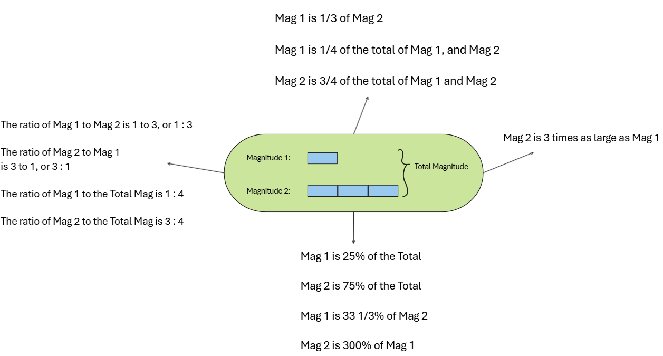
7.1 Fractions
7.1.1 Introduction to Fractions
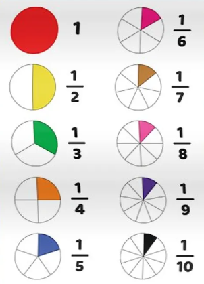
Fractions may be depicted using the regional model as you can see to the right. Using a bar diagram we will also depict fractions by highlighting the number of units that are being selected as the numerator, and the total number of units within the whole as the denominator. 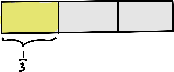 |
 |
|---|
We could also use the set model to represent fractions such as selecting \(\frac{1}{3}\) of the marbles when we have a total of 9 marbles:

Equivalent Fractions
Equivalent fractions are different fractions that represent the same part of a whole. Two fractions \(\frac{a}{b}\) and \(\frac{c}{d}\) are equivalent if they describe the same proportion, which can be determined by checking if their cross-products are equal: \(a\cdot d=b\cdot c\).
To obtain equivalent fractions from a single fraction, we multiply both the numerator and denominator by the same non-zero number. This procedure works because multiplying by the same number is equivalent to dividing the original parts of the whole into smaller, equal pieces without changing the overall proportion.
For example, consider the fraction \(\frac{1}{3}\). Imagine a pizza divided into 3 equal slices. If we further slice each of the 3 pieces in half, we now have 6 smaller slices. To represent the same portion of the pizza as before, we now need to select 2 of these smaller slices. This means \(\frac{1}{3}\) is equivalent to \(\frac{2}{6}\). Mathematically, this works because we multiplied both the numerator and denominator of \(\frac{1}{3}\) by 2.
This process can be repeated with any whole number to create additional equivalent fractions, such as \(\frac{3}{9}\) or \(\frac{4}{12}\), while preserving the value of the fraction. The key idea is that multiplying or dividing both parts of the fraction by the same factor doesn’t change the quantity it represents.
| Depiction of \(\frac{1}{2}\). The original bar has been split into two equal parts, and 1 is selected. | 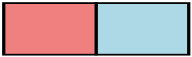 |
|---|---|
| Depiction of \(\frac{2}{4}\), which is equivalent to \(\frac{1}{2}\). The above 2 units have each been split equally into 2 additional units. This corresponds to multiplying the numerator and denominator by 2: \(\frac{1\cdot 2}{2\cdot 2}=\frac{2}{4}\) | 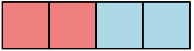 |
| Depiction of \(\frac{3}{6}\), which is equivalent to \(\frac{1}{2}\). The above 1 units have each been split equally into 3 additional units. This corresponds to multiplying the numerator and denominator by 3: \(\frac{1\cdot 3}{2\cdot }=\frac{3}{6}\) | 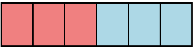 |
Property 1 of Fractions: (Equivalence) \(\frac{a}{b}=\frac{ak}{bk}\) for any nonzero whole number \(k\).
Mixed Numbers
Mixed numbers are a way of expressing quantities that combine whole numbers and fractions. For example, the mixed number 2½ represents two whole units and one-half of another unit. Mixed numbers are commonly used to describe measurements, quantities, or situations where whole parts and fractional parts are present together.

To convert a mixed number into an improper fraction, we first express the whole number as an equivalent fraction with the same denominator as the fractional part. Then, we add the numerator of this fraction to the numerator of the given fractional part. For instance, to convert 2½ into an improper fraction:
- Multiply the whole number (2) by the denominator of the fractional part (2), giving 4.
- Add this result to the numerator of the fractional part (1), giving 5.
- The resulting improper fraction is \(\frac{5}{2}\).
This procedural process basically corresponds to taking up a slicer, and slicing up the original 2 whole units into two equal parts, giving us a total of 5 slices, each of which is size ½.

To convert an improper fraction back into a mixed number, we reverse this process by dividing the numerator by the denominator to find the whole number part and the remainder. For example, to convert ¾ into a mixed number:
- Divide the numerator (5) by the denominator (2), which gives a quotient of 2 (the whole number part) and a remainder of 1.
- Write the remainder as the numerator of the fractional part, with the original denominator.
- The resulting mixed number is 2½.
While the conversion from mixed to improper involves slicing, the reverse process involves gluing the parts to form wholes again. This process highlights the close relationship between mixed numbers and improper fractions, allowing for flexible representation of the same quantity in different contexts.
Representing Fractions on a Number Line
To depict the mixed number 1 and 1/6 on an integral number line, we first draw a number line labeled with integers ranging from -3 to 3. The whole number 1 is placed between 0 and 2. To represent 1 and 1/6, divide the segment between 1 and 2 into 6 equal parts. Count one of these parts from 1 towards 2 and mark the point, which represents 1 and 1/6. This visual helps illustrate the position of mixed numbers relative to integers on a number line.

To depict the mixed number \(-2\ \frac{5}{6}\) on a number line it is first important to understand its meaning. The mixed number -2 5/6 does not mean -2 + 5/6; rather, it represents the opposite of (2 + 5/6), which amounts to multiplying that sum by -1. In other words, -2 5/6 means -2 - 5/6. On the number line, locate -2 between -3 and -1. Then, divide the segment between -2 and -3 into 6 equal parts. Count five of these parts from -2 towards -3 and mark the point, which represents -2 5/6. This emphasizes the proper interpretation of mixed numbers in negative contexts.

7.1.2 Multiplication of Fractions
| Let’s begin with a simpler case: what does it mean to multiply a fraction by a whole number? Suppose we want to compute \(\frac{2}{3}\) of 12cm. This amounts to first dividing the unit having magnitude 12cm into 3 equal parts, and selecting 2 of the parts. If 1 unit is \(12\div 3\ =\ 4cm\), then 2 units \(=\ 4cm\times 2\ =\ 8\ cm\) Thus, \(\frac{2}{3}\ of\ 12\ =\ 8\ cm\) | 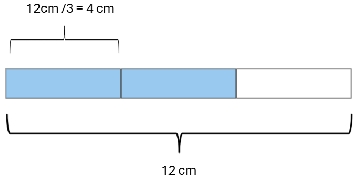 |
|---|
But how do we multiply two fractions? Say we’re multiplying \(\frac{2}{3}\times \frac{3}{5}\). We begin by depicting \(\frac{3}{5}\) of some whole, which represents 1 unit of magnitude:
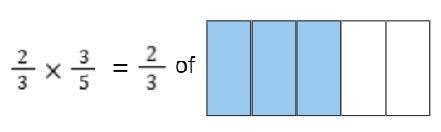
We now compute \(\frac{2}{3}\) of this \(\frac{3}{5}\) as depicted using a region model. We do this, by slicing the result horizontally, and selecting 2 of the horizontal copies:
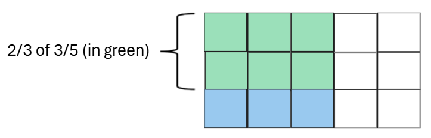
We now have the depiction of the final answer, but what is the answer? To compute this, we must determine the size of each small square. Since the original 1 unit was divided into a total of \(3\times 5\) many parts, each square represents \(1/15\) of the whole. We also have 2 rows, and 3 columns of these green squares as the answer, giving us a total of \(2\times 3=6\) many green squares. Thus, the answer must be \(\frac{6}{15}\). How could we have obtained this answer \(6/15\)? It appears we ultimately performed the following operation:\(\frac{2}{3}\times \frac{3}{5}=\frac{2\times 3}{3\times 5}=\frac{6}{15}\).
7.1.3 Addition & Subtraction of Fractions
| How do we add fractions with identical denominators? Firstly we must remind ourselves that the fractions must be referring to the same whole. Thus, if we’re combining \(\frac{1}{8}\) with \(\frac{2}{8}\), we must note that these both refer to the same original apple which was sliced into ⅛ pieces. Furthermore, it appears that must simply indicate that we have \(1+2=3\) slices in total, with a combined fraction of \(\frac{3}{8}\) . | 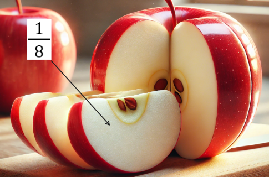 |
|---|
What if the slice sizes are different? We cannot simply combine slices of size \(\frac{1}{5}\) and \(\frac{1}{8}\). It makes no sense to just combine them.
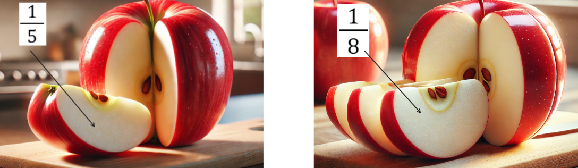
Instead, we must begin slicing up these slices already to make sure that we have a common slice size. If we split up each of the ⅕ size slices we would get slices where the denominator is a multiple of 5:
\(1/5,\ 1/10,\ 1/15,\ 1/20,\ etc..\)
Similarly, for the slice size that is ⅛:
\(1/8,\ 1/16,\ 1/24,\ 1/32,\ 1/40\)
The slice size that these sets of multiples have in common is \(\frac{1}{40}\) where LCM (5, 8) = 40! Thus, we begin by converting both fraction to one that has a denominator of 40, and then add:
\(\frac{1}{5}+\frac{1}{8}=\frac{8}{40}+\frac{5}{40}=\frac{8+5}{40}=\frac{13}{40}\)
7.1.4 Division of Fractions
Division as the Inverse of Multiplication
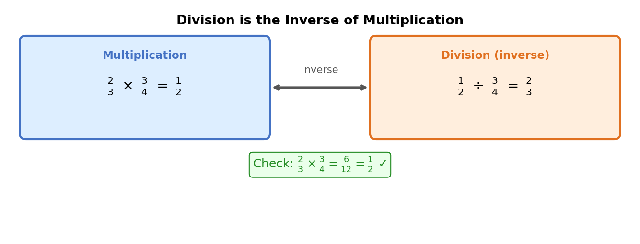
Recall that for whole numbers, division is the inverse operation of multiplication: if a × b = c, then c ÷ b = a. For example, 4 × 3 = 12, so 12 ÷ 3 = 4. The same relationship holds for fractions: since ⅔ × ¾ = ½, it follows that ½ ÷ ¾ = ⅔.
The Reciprocal
The reciprocal of a fraction a/b is b/a — the numerator and denominator are swapped. The key property of the reciprocal is:
(a/b) × (b/a) \= 1For example, the reciprocal of ¾ is ⁴⁄₃, and ¾ × ⁴⁄₃ = 1. Multiplying by b/a “undoes” multiplying by a/b — confirming that dividing by a fraction is equivalent to multiplying by its reciprocal.
Computing Division of Fractions
Because division is the inverse of multiplication, dividing by a fraction is equivalent to multiplying by its reciprocal:
(a/b) ÷ (c/d) \= (a/b) × (d/c)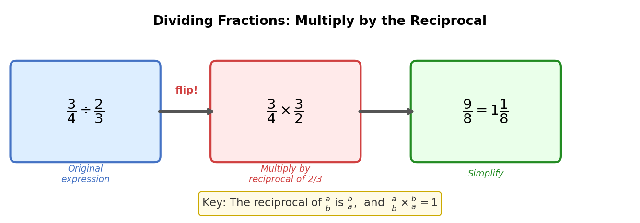
Example: (3/4) ÷ (2/3)
Step 1 — Keep 3/4.

Step 2 — Change ÷ to ×.

Step 3 — Flip 2/3 to get 3/2 (its reciprocal).

Step 4 — Multiply: (3/4) × (3/2) \= 9/8 \= 1⅛.
Bar Model Interpretation
Division of fractions can be understood using the measurement (quotitive) model: “How many groups of (c/d) fit inside (a/b)?”
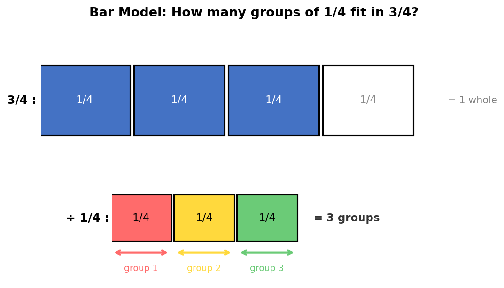
Example 1: 3/4 ÷ 1/4 = ? “How many groups of 1/4 are in 3/4?” Since 3/4 is made of three pieces of size 1/4, the answer is 3.
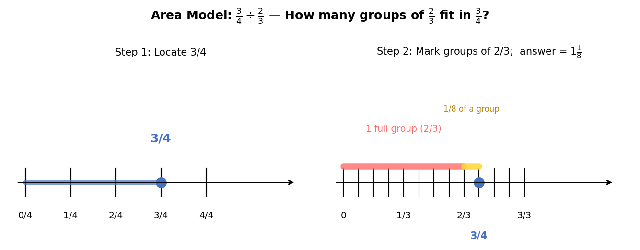
Example 2: 3/4 ÷ 2/3 = 9/8 = 1⅛. One full group of 2/3 fits inside 3/4, with an additional 1/8 of a group remaining.
Property 2 of Fractions: (Division)
For any fractions a/b and c/d (where c/d ≠ 0):
(a/b) ÷ (c/d) \= (a/b) × (d/c) \= (a × d) / (b × c)7.2 Exercises
A way to take a shortcut for multiplying by 25 is to use fractions, and to rewrite \(25=\frac{100}{4}\)\(25\times 64\ =\ \frac{100}{4}\times 64=100\times \frac{64}{4}=100\times 16=1600\). Use this methodology to perform the following operations mentally, but indicate the steps on your paper:
- \(25\times 48\)
- \(25\times 320\)
- \(884\times 25\)
- \(3212\times 25\)
- \(6416\times 25\)
- \(25\times 48\)
Calculate the following mentally, but show your thinking on paper. You need to use arithmetic properties:
- \(88\cdot \frac{3}{8}+88\cdot \frac{7}{8}\)
- \(48\times 99\ \frac{5}{12}\)
- \(1231\ -\ \frac{1}{70}\)
- \(12\ \frac{1}{3}-13\ \frac{2}{3}\)
- 17 \(\frac{2}{3}-19\ \frac{1}{3}\)
- \(1234\ -\ 17\ \frac{297}{300}\)
- $-34 +21 $
- \(-37\ \frac{7}{9}+19\ \frac{1}{3}\)
- \(88\cdot \frac{3}{8}+88\cdot \frac{7}{8}\)
Estimate the following to the nearest whole number:
- \(7\ \frac{1}{3}\)
- \(19\ \frac{7}{13}\)
- \(-19\ \frac{1}{3}\)
- \(24\ \frac{1}{4}\times 1\ \frac{2}{3}\)
- \(7\ \frac{1}{3}\)
Identify the following mixed numbers on the number line:
- \(7\ \frac{3}{4}\)
- \(-4\ \frac{3}{7}\)
- \(-3\ \frac{1}{4}\)
- \(7\ \frac{3}{4}\)
Identify whether the following word problems use measurement division (MD) or partitive division (PD). Represent it using a bar diagram.
- If it takes a half-yard of material to make an apron, how many aprons can be made with 4 yards of fabric?
- How many half bushels are there in \(3\ \frac{1}{3}\) bushels?
- The perimeter of a square flower bed is 64 feet. Find the length of each side.
- Mary poured 6 cups of juice equally into 10 glasses. How much was in each glass?
- How many laps around a \(\frac{1}{6}\) mile track make 6 miles?
- We drove 3246 miles from New York to San Francisco in 6 days. What was our average distance per day?
- If it takes a half-yard of material to make an apron, how many aprons can be made with 4 yards of fabric?
Solve the following word problems using a bar diagram. Be sure you provide a teachers’ solution.
- Kevin spent \(1/4\) of his money on a storybook. If the storybook cost $6, how much money did he have at first?
- \(4/5\) of the children in a choir are girls. (a) What fraction of the children are boys? (b) If there are 8 boys, how many children are there altogether? (c) How many more girls than boys are there?
- John mowed \(2/5\) of the lawn. His brother mowed \(1/4\) of it. What fraction of the lawn did they mow?
- Ali went a bookshop he spent \(3/5\) of his money on books and \(1/4\) of it on a pen. (a) What fraction of his money did he spend altogether? (b) What fraction of his money did he have left?
- Brianne made pineapple drinks by mixing pineapple syrup and water in the ratio 2 : 7. If she used 4 liters of pineapple syrup, how much water did she use?
- David cuts a rope 60 m long into two pieces in the ratio 2 : 3. What is the length of the shorter piece of rope?
- A pole 90 cm long, is painted green, white and black in the ratio 3 : 4 : 2. (a) What length of the pole is painted green? (b) What length of the pole is painted black?
- Kevin spent \(1/4\) of his money on a storybook. If the storybook cost $6, how much money did he have at first?
In chapter 3 of her book Knowing and Teaching Elementary Mathematics Liping Ma discussed the teaching of division by fractions. She reveals significant differences in conceptual understanding among teachers. Reflect on the importance of teachers having a deep conceptual understanding of division by fractions. How can teachers convey this understanding to their students, ensuring they grasp the concept rather than just learn a procedure such as “invert and multiply”? You may want to refer to the chapter on fractions in this book.
How are decimal addition/subtraction (Grade 5) and fraction addition/subtraction (Grade 6) connected to students’ earlier whole-number experiences? Describe a classroom scenario that helps students make a smooth transition from adding whole numbers to adding fractions or decimals
For each word problem below, (i) identify whether it uses Measurement Division (MD) or Partitive Division (PD), (ii) draw a bar diagram representing the situation, and (iii) compute the answer.
- A baker has 3/4 of a pound of butter. Each batch of cookies requires 1/8 of a pound of butter. How many batches can she make?
- Maria ran 5/6 of a mile in 2/3 of an hour. How far did she run in one full hour at the same pace?
- A piece of ribbon 3 1/2 yards long is cut into pieces each 1/4 yard long. How many pieces are there?
- If 2/3 of a tank of gasoline costs $24, how much does a full tank cost?
- A garden bed 4 1/2 feet wide is divided equally into sections that are each 3/4 of a foot wide. How many sections are there?
- A student spent 3/5 of her total homework time on mathematics. If she spent 3/4 of an hour on math, how long was her total homework session?
- A baker has 3/4 of a pound of butter. Each batch of cookies requires 1/8 of a pound of butter. How many batches can she make?
For each division problem below, draw two separate bar diagrams: one representing the Measurement (quotitive) interpretation and one representing the Partitive interpretation. Label each diagram clearly and state what question each interpretation answers.
- 3 ÷ 1/2
- 2/3 ÷ 1/6
- 1 1/2 ÷ 3/4
- 3 ÷ 1/2
Compute each of the following. Simplify your answer and express any improper fractions as mixed numbers. Problems are arranged from least to most difficult.
(a) 1/2 ÷ 1/4
(b) 3/4 ÷ 1/4
(c) 2/3 ÷ 1/3
(d) 5/6 ÷ 1/6
(e) 3/4 ÷ 1/2
(f) 2/3 ÷ 3/4
(g) 5/8 ÷ 3/4
(h) 1 1/2 ÷ 3/4
(i) 2 1/3 ÷ 1 3/4
(j) 3 1/2 ÷ 1 2/3