2 Numerals and Number Systems
2.1 Introduction
2.1.1 Why Learn Other Number Systems?
It is crucial for students training to become elementary school educators to be well-versed in historical number systems beyond the Hindu-Arabic numeral system they learned in school. Understanding systems such as the Roman numerals, the Babylonian sexagesimal system, or the quinary system can provide future educators with a broader perspective on mathematical concepts and their development. This exposure helps them appreciate the diverse ways humans have represented and manipulated numbers throughout history. By studying these different systems, future educators can gain insights into the challenges and cognitive processes involved in learning new numerical concepts, which is vital for teaching young students who are encountering these ideas for the first time.
The difficulty adults face in appreciating and sympathizing with students learning place-value concepts stems from their own deep-seated familiarity with base-10 numerals. Adults have been “indoctrinated” with the algorithms and methodologies of operating within this system, making it challenging to step outside their ingrained understanding. However, when exposed to alternative number systems such as the quinary or sexagesimal systems, future teachers are compelled to think critically about the algorithms underpinning the four basic operations: addition, subtraction, multiplication, and division. This critical engagement fosters a deeper understanding of mathematical principles and enhances their ability to teach these concepts effectively. By experiencing the learning process anew through different numerical frameworks, they become more empathetic and better equipped to support their students’ mathematical development.
2.1.2 Numeral, Numbers, and Number Systems
The notions of “number,” “numeral,” and “system of number representation” are fundamental in mathematics and have distinct meanings and implications. A number is an abstract concept used to represent quantity, order, and measurement. It is a fundamental idea in mathematics that exists independently of the symbols used to represent it. Philosophically, numbers have been interpreted in various ways. Platonism views numbers as abstract objects that exist in a non-physical realm, discovered rather than invented. Formalism sees numbers as purely symbolic entities defined by a set of rules and axioms within a formal system. Intuitionism considers numbers as mental constructs arising from the intuition of counting and ordering, rejecting the existence of numbers independent of the human mind. These philosophical perspectives highlight the abstract and foundational nature of numbers in mathematics.
In contrast, a numeral is a symbol, or a logogram used to represent a number. Numerals are the written or spoken representations of numbers and have varied historically across different cultures. For example, the ancient Egyptians used hieroglyphs to represent numbers, with a single stroke for 1, a heel bone symbol for 10, and a scroll for 100. The Babylonians utilized a base-60 (sexagesimal) system with cuneiform symbols (sometimes looking like a V), having separate symbols for 1 and 10 and combining them to form other numbers. Roman numerals employed combinations of letters from the Latin alphabet, such as I for 1, V for 5, X for 10, L for 50, C for 100, D for 500, and M for 1000. The Hindu-Arabic numeral system, the most widely used today, consists of ten digits from 0 to 9. These historical examples illustrate the diversity and evolution of numerals as symbols.
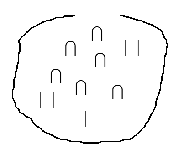
Additionally, the concept of a system of number representation refers to the method used to represent numbers. Different cultures have developed various systems for this purpose. For instance, the Romans used an additive and subtractive system where numbers were represented by combinations of symbols that either added up or subtracted to form a value. In contrast, prehistoric cave people used tally marks, a simple and direct system of representation. Systems of number representation can also be based on place value, where the position of a numeral within a number determines its value. The Egyptians used a place-value system in later periods, whereas earlier Egyptian numerals did not incorporate place value. The Babylonians’ sexagesimal system and the Hindu-Arabic numeral system are also examples of place-value systems, which allow for more efficient representation and calculation of large numbers.
The key differences between numbers, numerals, and systems of number representation lie in their nature and function. Numbers are abstract concepts with no physical form, while numerals are concrete symbols used to denote numbers. The concept of a number is universal and does not change across cultures or languages, but numerals vary across different cultures and historical periods. Systems of number representation define how numbers are symbolized and structured within a given culture. For example, the number 10 is represented as “10” in the Hindu-Arabic system, “X” in Roman numerals, and “𒌋” in Babylonian numerals, each following different representational rules. This distinction highlights the universality of numbers, the cultural specificity of numerals, and the methodological diversity of systems of number representation.
In summary, numbers, numerals, and systems of number representation are closely related but distinct concepts. Numbers are abstract entities representing quantity, order, and measurement, while numerals are the symbols used to express these abstract entities. Systems of number representation provide the framework within which numbers and numerals are organized and utilized. Understanding these concepts is crucial for grasping the foundations of mathematics and its historical development. The philosophical underpinnings of numbers emphasize their abstract and foundational nature, while the historical examples of numeral systems and number representation systems demonstrate the diversity and evolution of mathematical representation and methodology.
2.1.3 Place Value and No Place-Value Systems
Number systems play a crucial role in how societies understand and work with numbers. These systems can be broadly classified into two categories: those that use place-value and those that do not. Place-value systems, such as the Hindu-Arabic decimal system, assign value to a digit based not only on the digit itself but also on its position within the number. This concept allows for efficient representation and calculation, making it possible to express large numbers concisely. In contrast, non-place-value systems, such as Roman numerals or the tally system, do not assign significance to the position of symbols, often requiring different symbols or combinations to represent different values, which can lead to more cumbersome representations for large numbers.
To determine whether a number system is based on place-value, one can look for two key features: the recycling of symbols and the change in numerical value based on the position of these symbols. In place-value systems like the Hindu-Arabic decimal system, the same digit can represent vastly different values depending on its position—for example, the ‘2’ in ‘20’ represents twenty, while the ‘2’ in ‘200’ represents two hundred. This positional significance is also seen in other place-value systems like the Mayan vigesimal, which is based on the number 20, the Gumatj quinary, which uses base-5, and the Babylonian sexagesimal system, which is based on 60. On the other hand, non-place-value systems such as Roman numerals (I, V, X, etc.), tally marks, and the old Egyptian system use different symbols for different values and do not change the value of these symbols based on their order. These systems often have unique symbols for certain numbers and rely on additive or subtractive principles to combine symbols, lacking the efficiency and scalability of place-value systems. The recognition of symbol recycling and positional value is the hallmark of distinguishing a place-value system from those that do not use such a feature.
Below is the summary of the systems mentioned above.
| Place Value Systems | No Place-Value Systems |
|---|---|
| Babylonian Sexagesimal | Cave People Tally |
| Mayan Vigesimal | Old Egyptian |
| Gumatj Quinary | Roman Numeral |
| Hindu-Arabic Decimal |
2.2 Roman Number System
Roman numerals are a numerical system that originated in ancient Rome and were used throughout the Roman Empire. This system employs combinations of letters from the Latin alphabet (I, V, X, L, C, D, and M) to signify values. Unlike our modern decimal (base-10) system, Roman numerals are non-positional and based primarily on the use of addition and subtraction principles.
The symbols used in Roman numerals and their corresponding values are as follows:
I = 1
V = 5
X = 10
L = 50
C = 100
D = 500
M = 1,000
The basic concept behind Roman numerals is relatively simple: smaller numbers precede larger ones to indicate subtraction, while smaller numbers following larger ones indicate addition. For example, the numeral IV represents 4 (5 - 1), while VI represents 6 (5 + 1). Additionally, 49 would be written as IL.
Furthermore, there is no consistent way to represent some numbers. For example, one may represent 99 as IC (100-1), but also as LXXXIX (50+10+10+10+10+(10-1)), or as LXXXXVIIII (50+10+10+10+10+5+1+1+1+1). Obviously IC would be the most succinct way to represent this number.
Roman numerals were extensively used in various aspects of Roman life, including commerce, architecture, and literature. They appear on ancient monuments, in old manuscripts, and were used to number chapters in books, indicate hours on clocks, and denote important events and the names of monarchs and popes (e.g., Queen Elizabeth II).
2.3 The Old Egyptian Number System
The Old Egyptian numeral system which was developed around 3400 B.C., employs an additive system of counting, where the symbols of the numeral do not have to be in any special order or even on a line going from left to right. The seven symbols in this ancient system are listed below, along with their Hindu-Arabic equivalents.
| Symbol | Name | Value | Hindu-Arabic |
|---|---|---|---|
| 𓏤 | Staff | One | 1 |
| 𓎆 | Heelbone | Ten | 10 |
| 𓍢 | Scroll | Hundred | 100 |
| 𓆼 | Lotus flower | Thousand | 1,000 |
| 𓂭 | Pointing finger | Ten thousand | 10,000 |
| 𓆐 | Polliwog | Hundred thousand | 100,000 |
| 𓁨 | Astonished man | Million | 1,000,000 |
Here are two different ways to write the numeral sixty five in the Old Egyptian system:
𓎆𓎆𓎆𓎆𓎆𓎆𓏤𓏤𓏤𓏤𓏤
In this additive system, the Egyptian numeral 𓁨𓂭𓆼𓆼𓆼𓍢𓍢𓏤𓏤𓏤𓏤 represents
1,000,000 + 10,000 + 1,000 + 1,000 + 1,000 + 100 + 100 + 1 + 1 + 1 + 1 = 1,013,204.
Remember: The order in which the symbols are written is irrelevant in an additive system.
In addition to being able to write the symbols of the numeral in any order, you may also use a different combination of symbols used to represent the same number. Here are two different ways to write the number for one hundred twenty three:
𓍢𓎆𓎆𓏤𓏤𓏤 or 𓎆𓎆𓎆𓎆𓎆𓎆𓎆𓎆𓎆𓎆𓎆𓎆𓏤𓏤𓏤
2.4 The Gumaj People, and Quinary
The Gumaj (also spelled Gumatj) are one of the Yolngu peoples of Northern Australia, specifically located in Northeast Arnhem Land. They are part of a larger cultural group with rich traditions and a deep connection to their land, which they refer to as “Country.” The Yolngu people have been the traditional custodians of this area for thousands of years, with evidence of their presence dating back at least 65,000 years.
The Gumatj people use a unique base-5 (quinary) number system. This system is distinct because it revolves around the number five, a common feature in several traditional counting systems that are believed to be derived from counting using the fingers of one hand. Look at the columns labeled “Number”, and “Numeral” for now. Don’t look at the “Base 5” column. How would you say 6 in Gumatji language?
| Number | Base 5 | Numeral |
|---|---|---|
| 1 | 1 | wanggany |
| 2 | 2 | marrma |
| 3 | 3 | lurrkun |
| 4 | 4 | dambumiriw |
| 5 | 10 | wanggany rulu |
| 10 | 20 | marrma rulu |
| 15 | 30 | lurrkun rulu |
| 20 | 40 | dambumiriw rulu |
| 25 | 100 | dambumirri rulu |
| 50 | 200 | marrma dambumirri rulu |
| 75 | 300 | lurrkun dambumirri rulu |
| 100 | 400 | dambumiriw dambumirri rulu |
| 125 | 1000 | dambumirri dambumirri rulu |
| 625 | 10000 | dambumirri dambumirri dambumirri rulu |
2.4.1 Summary of the Gumaji Number System
Based on the diagram above: we have the following breakdown:
Numerals for 1-4:
1: wanggany
2: marrma
3: lurrkun
4: dambumiriw
Numeral for 5:
5: wanggany rulu (which translates to “one group of five” or “one hand”)
Combining Groups:
10: marrma rulu (two groups of five)
15: lurrkun rulu (three groups of five)
20: dambumiriw rulu (four groups of five)
25: dambumirriw rulu (five groups of five, marking a complete higher group)
Higher Multiples:
50: marrma dambumirri rulu (two groups of twenty-five)
75: lurrkun dambumirri rulu (three groups of twenty-five)
100: dambumirriw dambumirri rulu (four groups of twenty-five)
125: dambumirri dambumirri rulu (five groups of twenty-five, marking a higher grouping)
625: dambumirri dambumirri dambumirri rulu (five groups of one hundred twenty-five)
This system shows a clear hierarchical structure where the numbers are grouped by fives, and larger numbers are created by combining these groups. The use of terms such as “rulu” indicates multiplication by the base number 5, and higher orders are expressed by repeating these groupings. This structure allows for an efficient representation of numbers in the base-5 system, reflecting the Gumatj’s unique mathematical approach.
2.4.2 Understanding Base 5 Representation
Single-Digit Numbers (0-4): These are straightforward, as they are the same in both base-5 and base-10 up to 4.
Multi-Digit Numbers: To write a number in base 5 we will generally place a small 5 symbol below a number such as: \(2{3}_{5}\). This means that the “23” is not in base-10 but in base-5. What is the meaning of \(2{3}_{5}\)? This means we have 2 fives, and 3 ones. So, \(2{3}_{5}=2\cdot 5+3\cdot 1\). Note however that \({5}^{0}=1\) and \({5}^{1}=5\). This means that we can equivalently write:
\(2{3}_{5}=2\cdot {5}^{1}+3\cdot {5}^{0}\)
Now look at the base-5 column in the table above. Here is a summary of the meaning behind each of the rows:
2.4.3 Converting a Base-5 Number into Base-10
To convert a number from base-5 to base-10, you follow a systematic process that involves multiplying each digit of the base-5 number by the power of 5 corresponding to its position and then summing the results. Here’s a step-by-step guide to help you understand this conversion process:
Step 1: Identify the Digits and Their Positions: Each digit in a base-5 number has a positional value, which is a power of 5. The rightmost digit is at position 0 (5^0), the next digit to the left is at position 1 (5^1), and so on.
Step 2: Multiply Each Digit by Its Positional Value:
Step 3: For each digit, multiply it by 5 raised to the power of its position
Step 4: Sum the Results: Add all the products obtained in step 2 to get the equivalent base-10 number.
Example 1: Convert $32{4}_{5}$to base 10:
We have 4 in the ones (a.k.a. pennies) place, 2 in the fives (a.k.a. nickels) place, and 3 in the twenty-fives (a.k.a. quarters). Thus we combined these values:
\(32{4}_{5}=3\cdot {5}^{2}+2\cdot {5}^{1}+4\cdot {5}^{0}=3\cdot 25+2\cdot 5+4\cdot 1=75+10+4=89\)
Example 2: Convert $403{1}_{5}$to base 10:
We have 1 in the ones place, 3 in the fives place, 0 in the twenty-fives (a.k.a.
quarters) place, and 4 in the 125s place.. Thus we combined these values:
\(403{1}_{5}=4\cdot {5}^{3\ }+0\cdot {5}^{2}+3\cdot {5}^{1}+1\cdot {5}^{0}=4\cdot 125\ +0\cdot 25+3\cdot 5+1\cdot 1\)
\(=500+15+1=516\)
2.4.4 Converting Base-10 Numbers to Base-5
To convert a number from base-10 to base-5, you repeatedly divide the number by 5 and record the remainders. The process involves:
Step 1: Divide the number by 5.
Step 2: Record the remainder as the least significant digit (rightmost position).
Step 3: Update the number to the quotient of the division.
Step 4: Repeat the process until the quotient is 0.
Step 5: Read the remainders in reverse order to get the base-5 number.
Example: Convert 73 to base-5
- Divide 73 by 5:
- 73÷5=14 remainder 3 (write down 3)
- 73÷5=14 remainder
- 73÷5=14 remainder 3 (write down 3)
- Divide 14 by 5:
- 14÷5=2 remainder 4 (write down 4)
- 14÷5=2 remainder 4 (write down 4)
- Divide 2 by 5:
- 2÷5=0 remainder 2 (write down 2)
- 2÷5=0 remainder 2 (write down 2)
- The remainders are 2, 3, and 3. Reading them in reverse gives \(24{3}_{5}\). So, \(7{3}_{10\ }=24{3}_{5}\)
| 2.5. The Babylonian Number System The Babylonian civilization, flourishing in ancient Mesopotamia between the Tigris and Euphrates rivers, is renowned for its remarkable contributions to writing, mathematics, and administration. They developed one of the earliest writing systems, known as cuneiform, which involved inscribing wedge-shaped symbols onto clay tablets using a reed stylus. These clay tablets have provided a wealth of evidence demonstrating the Babylonians’ sophisticated mathematical practices, which were integral to their society. Mathematical texts, often found among administrative records, indicate that Babylonians engaged in complex calculations for various practical purposes, including trade, agriculture, and astronomy. Students in Babylonian schools practiced mathematics by solving problems inscribed on clay tablets, often working through intricate exercises involving arithmetic and geometry. This hands-on method of learning ensured that mathematical knowledge was both practical and enduring, as the clay tablets have preserved these ancient teachings for millennia. | 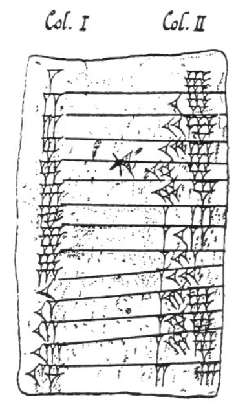 |
|---|
Take a look at the tablet to the right. It’s made of two columns. The symbol  represents 1, while the symbol
  represents 10. This is a remnant of a base-10 system. However, the Babylonian number system does not use base 10. Try to guess what the numbers on Col. II represent, and what was the purpose of this specific tablet. This is about 3rd grade level mathematics!
Below are the 59 symbols that we could build using the two symbols above:
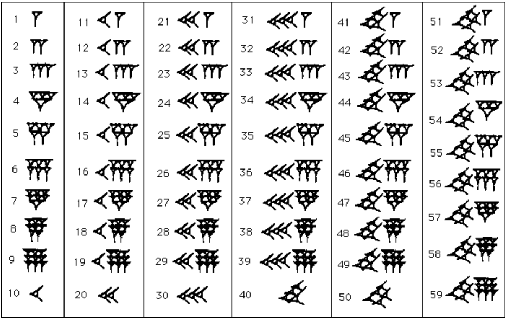
It should be clear that the Babylonians used a base-60, or sexagesimal system for enumeration. The place values were ones, sixties, sixty sixties, sixty copies of sixty sixties, and so on… For example, the number  has 40 ones, 46 sixties, 57 sixty sixties, and 1 sixty sixty sixties. This can be written in our notation as:
 = \(1\times 6{0}^{3}+57\times 6{0}^{2}+46\times 60+40=424,000\)
2.5 The Mayan Number System1
The Mayan vigesimal (base-20) number system was an essential part of Maya civilization, used in a variety of contexts, including trade, astronomy, and their complex calendar systems. The Maya tracked time using three interrelated calendars: the Tzolk’in (a 260-day ritual calendar), the Haab’ (a 365-day solar calendar), and the Long Count calendar, which was used for recording historical events over long periods. The Long Count calendar, in particular, relied on the vigesimal system, using place values that increased in multiples of 20, except for the second place, which increased by 18 to align with the Haab’ cycle. This mathematical structure allowed the Maya to record dates spanning thousands of years with remarkable precision, demonstrating their advanced understanding of numerical systems.
One of the most significant surviving Mayan texts is the Dresden Codex, which contains extensive mathematical and astronomical calculations. This codex, written in hieroglyphs on bark paper made from the Mate tree (ficus species), documents lunar and solar cycles, planetary movements, and even eclipses with astonishing accuracy. Along with the Madrid Codex, Paris Codex, and Grolier Codex, it is one of the few surviving pre-Columbian Mayan books, as most were burned by Spanish Christian missionaries during the conquest, particularly under Bishop Diego de Landa in the 16th century. The Dresden Codex is especially valuable because it includes detailed tables for predicting eclipses, Venus cycles, and the movement of other celestial bodies, showcasing the Maya’s sophisticated knowledge of astronomy and mathematics. This codex serves as a critical source for understanding how the Maya applied their vigesimal system in practical and ceremonial contexts, cementing their reputation as one of the most mathematically advanced ancient civilizations.
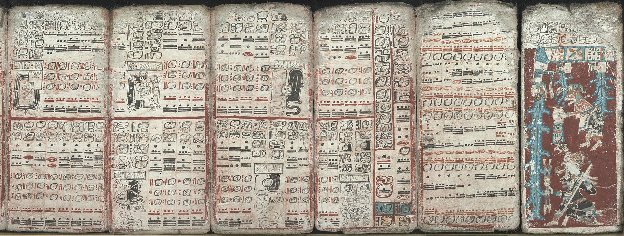
Some Mayan numerals are shown below. Try to figure out the pattern and then fill in the missing numerals.
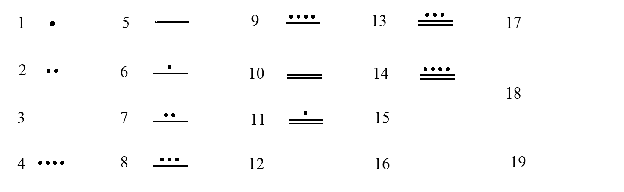
From what you have seen of this system so far, it might look like a simple additive system. One might guess that the numeral for 20 would be four line segments and that the numeral for 103 would be twenty line segments and three dots. At first glance, it is very similar to the tally system. However, the Mayans used a vertical positional system. The bottom level represented how many units (or ones), the second level up represented how many 20’s, the third level up represented how many 360’s (20 18), the fourth level up represented how many 7200’s (20 18 20), the fifth level up represented how many 144,000’s (20 18 20 20), etc. Except between the second and third level, each place value increased by a multiple of 20. It is almost a Base Twenty system except for that strange third level. Why the third level is 18 times the second level is explained later. Looking at the chart to the left, which shows the first four place values, may help you understand the system.
To try and make sense of all of this, we will look at some Mayan numerals that have more than one position now. The numerals from one to nineteen only utilize the bottom level so it isn’t apparent that the Mayan system is positional until you count past nineteen.
| To the left is a two-level Mayan numeral. There is a 16 in the bottom level, representing 16 ones, or 16 (\(16\times 1\)), plus there is a 7 in the second level up, representing 7 groups of twenty, or 140 (\(7\times 20\)). We add the values of each level, 16 + 140, so the numeral you see represents 156. |
|---|
You have seen two basic symbols in this system so far –a dot (▪ ), which represents the number one and a line segment (___), which represents the number five. As previously mentioned, there needs to be a symbol for zero to incorporate the use of place value. For that, the Mayans used a shell that looked something like this: .𝋠
To the left is a two level Mayan numeral with a zero in the bottom level, representing zero ones, or 0, plus a 13 in the second level up representing 13 groups of twenty, or 260 (\(13\times 20\)). So after adding the values together (0 + 260), the numeral you see represents the number 260.
State the Hindu-Arabic equivalent of each Mayan numeral. Show how you obtained your answers.

Now, we’ll go on to some three and four level Mayan numeral. Remember that the place value for the third level up is 360 and the place value for the fourth level up is 7200. See if you can figure these out on your own first.
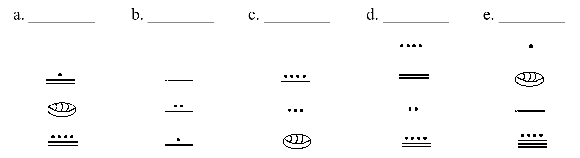
To convert a number to a Mayan numeral, the first thing you’ll have to determine is how many levels the numeral will have. Remember the levels: 1, 20, 360, 7200, 144000, 2880000, etc. So any numeral less than 20 has one level, a numeral between 20 and 359 has two levels, a numeral between 360 and 7199 has three levels, a numeral between 7200 and 143999 has four levels, and so on.
It might help if you set up a table with the correct number of levels set up already with a space to fill in what symbol you’ll be using at each level. For instance, look below at the four most common charts you’ll be using.
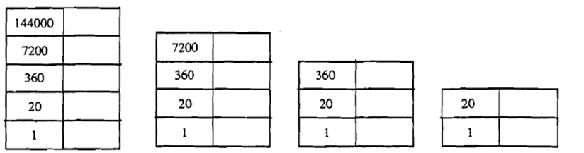
Let’s start with the number 174. Convince yourself that this will be a two level numeral. We’ll start at the top, which is the 20’s place value. We have to ask ourselves how many 20’s are in 174? This is a division question: \(174\div 20\) = 8, remainder 14. We can begin to construct the Mayan numeral by starting with the two-level chart and filling an 8 in second level up as shown below.
So far, we have eight groups of twenty, or 160 filled in, which leaves 14 more (the remainder) to accommodate. When you get down to the units place, the remainder is filled in there. So the next step is to fill 14 in the units place. Do that in the vacant place in the chart shown. Before feeling satisfied that everything is correct, check your answer by computing the Mayan numeral you have just constructed and see if it is indeed 174. Then, get rid of the chart and write the answer as a Mayan numeral as shown to the right.
Let’s try another number. We’ll convert 6017 to a Mayan numeral. This will be a three level numeral, so we’ll start off with a three level chart and figure out how many 360’s are in 6017. We do this division problem: \(6017\div 360\) = 16, remainder 257. This tells us to put the symbol for 16 in the third level up (360’s place). Now we have to take the remainder, 257, and find out how many 20’s there are in it to find out what to put in the second level. We do this division problem: \(257\div 20\) = 12, remainder 17. Since only the units place value is left (the bottom level), the remainder of 17 goes in that level. The sequence of filling in the charts is shown below. Make sure you go back and check your work by converting the numeral back to Hindu-Arabic (\(1\div 17+12\div 20+16\div 360\)) and seeing if it really equals 6017.

Before proceeding, we will show a straightforward method for determining the quotient and remainder using a basic calculator for division problems. If you are already proficient in this or your calculator provides the result automatically, you may skip to Exercise 8. Consider converting the number 5263 to the Mayan numeral system. The initial division you would perform is 5263 ÷ 360. When executed on a calculator, the result appears as approximately 14.619444. This indicates there are 14 whole 360s in 5263, but the remainder is not immediately clear. Therefore, you would place 14 in the third level up. To find the remainder, input 14 × 360 - 5263 into the calculator. Ignoring the negative sign, the result is the remainder, which in this case is 223. Remember, the remainder must be less than the divisor, which is 360 in this instance.
To find the next value, we would take the remainder of 223 and divide it by 20. Continuing without a calculator might be feasible. Now, let’s find the quotient and remainder when dividing 24567 by 7200. On the calculator, 24567 ÷ 7200 results in approximately 3.4120833. Therefore, the quotient is 3. To determine the remainder, input 3 × 7200 - 24567, yielding a remainder of 2967 (which is less than 7200). Thus, the answer is 3 with a remainder of 2967. To verify, 7200 × 3 + 2967 should equal 24567. Consider why this process is effective and apply it to the subsequent problems.
Use a calculator to find the quotient and remainder for these division problems.
a. 9876$\div$360 \=                                         b. 71509$\div$7200 \=


c. 333$\div$20 \=                                               d. 430040$\div$144000 \=    —---------------------------
Let’s convert 71509 to Mayan. Fill in the Mayan symbols on the chart to the left as we work through the problem. This is a four level Mayan numeral and Exercise 8b should help us get started! Did you get 9, remainder 6709? So 9 is in the fourth level up. Now, we compute: 6709 360 = 18, remainder 229. So 18 is in the third level up. Next computation: 229 20 = 11, remainder 9, so 11 is the second level up and that leaves 9 in the units place. The final answer is shown to the right.
You may be wondering why the Mayans chose 360 for the third level up instead of 400, which seems more natural. Their counting system was based on their calendar, which consisted of 18 months of 20 days each, hence 360. The extra five days were considered “useless” and they didn’t worry about them. Their system made it easy to count time. They didn’t count the “useless days.” For instance, consider the following:

2.6 Exercises2
Consider the stroke system where there was only one symbol, a simple vertical stroke, to express a number. A vertical stroke like this, |, expressed one. To express the number seven, you would write seven strokes: | | | | | | |
Show how you would write the numeral eleven in stroke :
Describe in words how to write the numerals five hundred twelve ; and two million in STROKE. Don’t attempt to write the actual strokes!! We only have a semester!
Name some advantages and disadvantages of the stroke system, compared with the Hindu-Arabic system.
The tally system improved the stroke system by introducing the concept of grouping. You are probably familiar with this system where the fifth stroke was placed across the previous four so it would be easier to read since you can count by fives. Stroke is a single symbol system, but Tally can be thought of as a two symbol system, although the second symbol is really just made up of five strokes. Note the difference in writing the numeral twenty-eight in the two systems.
STROKE system: Tally system:

- Write the numeral for 17 in the stroke system.
- Write the numeral for 17 in the tally system.
Explain in words two more ways you could write the numeral one hundred twenty three by using a different combination of symbols in Old Egyptian.
Express each Egyptian numeral below as a Hindu-Arabic numeral. Show work.



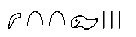
Babylonian numeral with 1 finger, 2 heels, 1 Polliwogs, and 3 tallies.
Explain the philosophical interpretations of numbers and how each view conceptualizes the nature of numbers. For example, what do formalist philosophers say what “number” is? What about the Platonists?
Describe the differences between a number and a numeral, providing two historical examples of different numeral systems. Try providing examples not already discussed in this book. You may have to do some external research.
What is a system of number representation, and how does it differ from a numeral? Provide examples of different systems of number representation.
Write the Mayan numeral equivalents for each of the following numbers:
- 1 b. 20 c. 360 d. 7200 e. 144000
Think about the highest numeral value that can be on any given level. For instance, the bottom level could go up to 19, or 𝋳 . But what about the second level up? What number would be represented by a two level Mayan numeral if there was a 19 at the second level up and a zero at the bottom level? Write the Mayan numeral for 380.
What is the highest Mayan numeral value that should be on the second level up? What is the highest Mayan symbol that could be on any level except the second level up?
Write the Mayan numeral for the number of (non-useless) days in:
- 7 months, 15 days b. 13 Mayan years c. 20 Mayan years
- Convert the following numbers into Roman Numerals. Use the most succinct methodology:
- 89
- 544
- 3766
- 1669
- 9999
- Convert the following numbers from Roman Numerals into Hindu-Arabic:
- LXXIV
- CDXLV
- CMXCIX
- MMXVII
- MMCDXLIX
- Perform the following operations in Roman Numerals:
- Fill in the blank: XXX + XX = _____ (Roman numeral)
- Fill in the blank: C - L = _____ (Roman numeral)
- Fill in the blank: D + C = _____ (Roman numeral)
- Fill in the blank: M - CD = _____ (Roman numeral)
- Convert the following numbers written in Quinary into Base-10:
- \((34{)}_{5}\)
- \((201{)}_{5}\)
- \((1111{)}_{5}\)
- \((1001{)}_{5}\)
- \((10303{)}_{5}\)
- Perform the following operations in Quinary. Be sure to use base-5 thinking when doing the operations, and write the answer in base-5:
- \((201{)}_{5}+(111{)}_{5}\)
- \((34{)}_{5}+(21{)}_{5}\)
- \((132{)}_{5}+(444{)}_{5}\)
- \((342{)}_{5}-(121{)}_{5}\)
- \((1002{)}_{5}-(43{)}_{5}\)
- \((2003{)}_{5}-(4{)}_{5}\)
- Convert the following numbers into Quinary:
- 79
- 32
- 107
- 99
- 126
- 629
- Convert the following numbers into Babylonian Sexageximal. Write the answers in Babylonian notation.
- 72
- 123
- 3601
- 3663
- 613
- 13762
- Convert the following Babylonian numbers into Hindu-Arabic:


Babylonian numeral with the symbol for 1 separated by 5 symbols for 10, and 7 symbols for 1. (c)  (d)  (e) 
- Perform the following subtraction operations. Be sure to show all the steps on your paper involving the operation, or explain your steps using words. How does this exercise relate to the Babylonian number system?
\(1\ hour,\ 23\ min,\ 34\ sec\ \ +\ 3\ hours,\ 42\ min,\ 55\ sec\)
\(2\ hours,\ 33\ min,\ 14\ sec\ -\ 1\ hour,\ 44\ min,\ 33\ sec\)
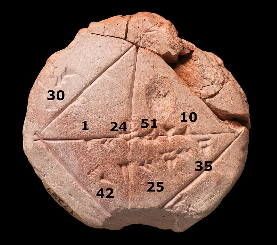
- The tablet below is YBC - 72383. It shows a square with side length 30. The diagonal of the square is labeled with two sexagesimal numbers. The first of these two, 1.24,51,10 represents the number 305470/216000 ≈ 1.414213, a numerical approximation of the square root of two that is off by less than one part in two million. The second of the two numbers is 42.25,35 = 30547/720 ≈ 42.426. This number is the result of multiplying 30 by the given approximation to the square root of two, and approximates the length of the diagonal of a square of side length 30. How is the number 1.24,51,10 an approximation of \(\sqrt{2}\)? All the numbers following the sexagesimal point represent multiples of reciprocals of \(60,\ 6{0}^{2},\ 6{0}^{3}\ etc..\) Show that 1.24,51,10 \(\approx \ \sqrt{2}\), and show that 42.25,35 \(\approx 42.426\).
This section is partially adopted from Julia Harland, Understanding Elementary Mathematics↩︎
Some of these exercises were adopted from Cindy Moss, Counting and Numerals A hands-on workbook↩︎
https://en.wikipedia.org/wiki/YBC_7289#:~:text=YBC%207289%20is%20a%20Babylonian,.%20in%20the%20ancient%20world%22.↩︎