4 Forming, and Solving Word Problems using Bar Diagrams
4.1 Introduction to Word Problems Using Bar Diagrams
4.1.1 The Teacher’s Solution
Welcome to the engaging world of word problems through the lens of bar diagrams, a cornerstone chapter for aspiring elementary mathematics educators. This chapter is meticulously designed to bridge the fundamental mathematical concepts of 1st to 6th grade, providing a thorough understanding of problem-solving techniques that don’t rely on algebra but instead utilize the visual and logical power of bar or strip diagrams.
Word problems, often viewed as challenging puzzles, are vital for developing students’ mathematical reasoning and critical thinking skills. They simulate real-life scenarios where mathematics is not just abstract numbers but tools for solving tangible problems. By introducing bar diagrams, we offer both students and educators a versatile technique to break down and understand these problems in a visual format, making the abstract nature of mathematics more concrete and approachable.
This chapter is divided into two main sections: the first covers grades 1 through 4, laying the foundation with simpler problems to build confidence and understanding. The second section escalates to grades 5 and 6, introducing more complex scenarios that require a deeper analytical approach, preparing both teachers and students for the challenges ahead. Although we steer clear of algebraic solutions as a primary method, select word problems will include algebraic solutions for a more comprehensive understanding, demonstrating the parallel between elementary and advanced problem-solving strategies.
For educators, mastering the art of presenting “teacher solutions” is crucial. This involves three key steps:
- Labeling all Given Information: Start by identifying and marking all the available data in the word problem. Use a bar diagram to visually represent this information, placing a question mark (?) where the desired value should be. This initial step is essential for organizing thoughts and setting the stage for problem-solving.
- Clear and Reasoned Computations: Once the information is laid out, the next step involves detailing the computations needed to arrive at the solution. These computations should be shown in a step-by-step manner within the framework of the bar diagram. This approach not only aids in solving the problem at hand but also in explaining the reasoning behind each step, making it an invaluable teaching tool.
- Stating the Answer in a Complete Sentence: The final step is to articulate the solution clearly and concisely in a complete sentence. This practice reinforces the importance of communication in mathematics and ensures that the solution is not just a number but a well-explained answer to the problem posed.
By the end of this chapter, educators will be equipped with the necessary skills to guide their students through the world of word problems using bar diagrams. This method not only enhances problem-solving skills but also fosters a deeper understanding and appreciation of mathematics as a practical and vital tool in everyday life. Let’s embark on this journey together, unraveling the mysteries of word problems with clarity, creativity, and confidence.
4.1.2 The Differing Methodologies, and Gradations of Difficulty
The mastery of diverse methodologies in presenting word problems is not just an advantage but a necessity for every effective teacher. In the diverse landscape of a classroom, each student possesses unique cognitive skills and learning preferences. The ability to approach a problem through various methods ensures that teaching is not a one-size-fits-all affair but a flexible, adaptive process that meets students where they are. This versatility in teaching methodologies not only accommodates the differing abilities of students but also nurtures their critical thinking skills. By being exposed to multiple problem-solving techniques, students learn that there are several paths to reach a solution, encouraging them to think more broadly and creatively about problems. This aspect is particularly crucial in environments that promote guided inquiry, where students are encouraged to explore and propose alternative solutions. A teacher adept in various methodologies is better prepared to recognize, validate, and discuss these alternative solutions, fostering a classroom culture where students feel valued for their contributions and are motivated to engage deeply with mathematical concepts.
Moreover, the inclusion of multiple problem-solving strategies within the curriculum underscores the importance of adaptability and perseverance in learning. It sends a powerful message to students: that struggle and exploration are natural and necessary parts of the learning process. When teachers present different ways to tackle a word problem, they highlight the iterative nature of problem-solving and demonstrate that setbacks are merely steps towards understanding. This approach not only builds mathematical resilience but also instills a sense of curiosity and openness to new ideas among students. By embracing this pedagogical flexibility, educators empower their students to approach problems with confidence, equipped with a toolkit of strategies to navigate the complexities of mathematics and, by extension, real-life challenges. Through this dynamic and responsive teaching style, educators can cultivate a classroom atmosphere that values creativity, encourages risk-taking, and celebrates the diverse ways of thinking and understanding that each student brings to the table.
Understanding and implementing “gradations of difficulty” in word problems is a critical skill for teachers, one that serves dual purposes in the educational journey of their students. Firstly, it addresses the inherent diversity of abilities within any classroom, ensuring that each student, regardless of their starting point, can engage with mathematics in a meaningful and accessible way. Secondly, it is a deliberate pedagogical strategy aimed at building students’ critical thinking and problem-solving skills progressively. By carefully structuring word problems from simple to more complex, teachers can scaffold students’ learning experiences, allowing them to build confidence and competence step by step. This methodical approach encourages students to apply previous knowledge to new challenges, promoting a deeper understanding and retention of mathematical concepts.
The word problems presented in this chapter follow a rough scale from easy to difficult, serving as a model for educators. However, this progression is intended as a guide rather than a strict framework. Teachers are encouraged to tailor these gradations to fit the unique needs and abilities of their students, developing custom “steps of difficulty” that resonate with their specific classroom dynamics. This customization is not just about adjusting the complexity of the problems but also about choosing contexts and scenarios that are relevant and engaging to the students, thus enhancing their connection to the material. By crafting word problems that gradually increase in difficulty and are attuned to their students’ interests and experiences, teachers can foster a more inclusive, stimulating, and effective learning environment. This approach not only supports the varied learning trajectories of students but also enriches their mathematical journey, preparing them for more advanced concepts and real-world applications.
4.2 Grades 1-4 Word Problems
Solving word problems in grades 1-4 introduces young learners to the foundational skills of understanding, interpreting, and solving mathematical situations in a contextual form. Teaching word problems effectively involves not only helping students grasp the numerical content but also adjusting the level of difficulty through varying the structure of the problems. This approach deepens students’ conceptual understanding and problem-solving abilities, equipping them with flexible thinking.
Numerical vs. Structural Variation
When we think about modifying word problems, it’s helpful to understand two main types of variation: numerical and structural. Though there’s no sharp boundary between the two, they each play a distinct role in developing mathematical skills.
Numerical Variation: A numerical change involves altering only the numbers within a problem without changing the underlying structure. For example, changing “Mary has 3 apples, and she buys 2 more” to “Mary has 6 apples, and she buys 4 more” modifies the values but maintains the same operation (addition) and the same basic concept (combining). This change typically requires minimal cognitive adaptation on the part of the student, as they’re applying the same reasoning and simply recalculating based on new values. Numerical variations are useful for practicing a particular operation or reinforcing a concept.
Structural Variation: A structural change, on the other hand, adjusts the way the problem is framed, potentially changing the entire representation needed to solve it. This might involve shifting from an addition scenario to a comparison or from a single-step problem to a two-step problem, requiring students to redraw or rethink their bar diagrams or other visual aids. Structural variation challenges students to recognize deeper connections and relationships within the problem. For instance, changing a simple addition problem about combining two groups to a comparison problem where one amount exceeds another by a given value requires a different setup and encourages more critical thinking.
Raising the Pedagogical Level
Teachers can enhance the pedagogical impact of word problems by being aware of these variations and knowing how to apply them. While numerical variation reinforces procedural fluency, structural variation develops adaptive reasoning, preparing students to approach problems with flexibility and critical thinking. Structuring the learning environment in this way allows teachers to scaffold students’ skills progressively, moving from routine calculation to more complex analysis.
The following sections are organized roughly in terms of structural variability. Within each section we will explore smaller gradations of structural variability.
4.2.1 Comparative Difference
Example 1: We have two missing numbers. The second number is 7 more than the first number. Their sum is 25. What are the numbers?
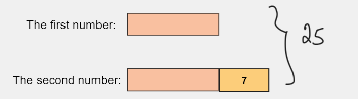
Method 1: The idea is to remove the extra magnitude 7 from the second number, resulting in a total of 25-7 = 18.
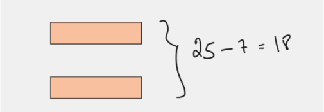
2 units \= 18

1 unit \= $18\div 2=9$

The larger number is $9+7\ =16$, while the smaller number is 9\.
Method 2: The idea is to add an additional 7 to the first number to ensure that both numbers are equal, resulting in a total of 25 + 7 = 32.
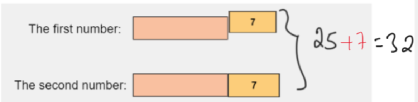
2 units \= 321 unit = \(32\div 2=16\)
The larger number is \(16\), while the smaller number is \(16-7=9\).
Method 3: Utilizing Algebra
    Let the smaller number be:  n
    Therefore the larger number will be:  n+7
    Their sum is 24 can be translated as:  $n+(n+7)\ =\ 25$
    We can now solve the equation as follows:
\(n+n+7=25\)
\(2n+7=25\)
\(2n=25-7\)
\(2n=18\)
\(n=18\div 2\)
\(n=9\)
This indicates that the smaller number 9, therefore the larger number is
\(9+7=16\).
4.2.2 Comparative Multiples
Example 1: Joe has 3 times as many toy cars as Jose. Together they have 64 toy cars. How many toy cars does Joe have?
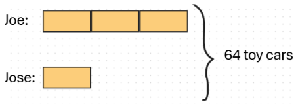 |
4 units = 64 cars 1 unit = \(64\div 4\) = 16 cars Joe has 3 units of cars, so \(3\times 16=48\) cars. |
|---|
In this word problem changing the total number of toy cars (e.g., from 64 to 72) is a trivial, numerical variation. This only requires recalculating based on a new total but does not alter the underlying relationship or setup; the same bar diagram with 4 parts (3 parts for Joe and 1 for Jose) still applies. However, changing the “3 times” relationship to, say, “Joe has 2 times as many toy cars as Jose” results in a structural, albeit mildly, variation. This adjustment requires modifying the representation, as now only 3 parts are needed in the bar diagram (2 parts for Joe and 1 for Jose), reflecting a different underlying relationship.
We can vary the structure of the problem even further by introducing the idea that Jose may have 2 units of cars for every 3 units that Joe has. For this, we will use ratios (see Chapter 7 for more details). Here’s the variation:
Example 2: The ratio of Joe’s toy cars to Jose’s toy cars is 3 to 2. Together they have 65 toy cars. How many toy cars does Joe have?
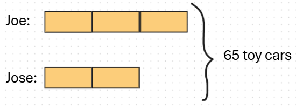 |
5 units = 65 cars 1 unit = \(65\div 5\) = 15 cars Joe has 3 units of cars, so \(3\times 15=45\) cars. |
|---|
By the way, the wording of this problem can also be changed so as to adapt it for a topic involving fractions (See chapter 7 again). Instead of saying their ratios are 3:2, we could say, “Jose had 1 and ½ times as many toy cars as Jose,” or equivalently, “Jose has ⅔ as many toy cars as Joe”.
In the above two examples we have a relationship between the units of toy cars of the two people based on multiples, but we are still dealing with two people. We can raise the bar a bit higher by introducing a third person:
Example 3: Jose has 3 times as many marbles as Carolina, while Joey has 2 times as many marbles. Together, the three kids have 36 marbles. How many marbles does Jose have?
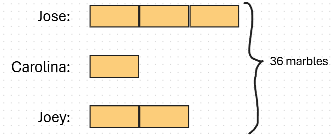 |
6 units = 36 marbles 1 unit = 36 / 6 = 6 marbles Jose has 3 units = 3 * 6 = 18 marbles |
|---|
By the way, this same word problem structure can be expressed more succinctly in terms of ratios as follows: The ratio of Jose’s to Carolina’s to Joey’s marbles is 3:1:2.
Now that we have three children involved in the problem, we can vary the structure a bit more by mixing comparative difference, and comparative multiples as follows:
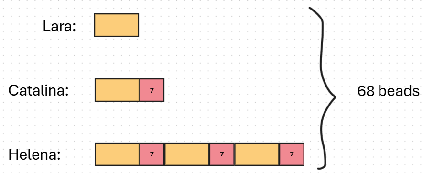
Example 4: Helena has 3 times as many beads as Catalina, while Catalina has 7 more beads than Lara. Together they have 68 beads. How many beads does Lara have?
Below is the initial setup of the problem. Note that added complication that Helena’s units must include the multiple copies of the extra 7 units that Catalina has. This is because Helena’s beads are 3 times as many as Catalina’s.
Method 1 Solution: Adding the missing 7 unit bar
The strategy here is to ensure that we have equal units of the type  so that their total can be equally divided into what appears to be 5 equal units. All that is requires is to add a 7 unit piece
  to Lara’s unit, and therefore also to the total of 68, obtaining 75 beads.
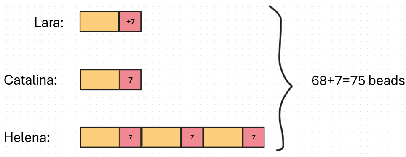 |
5 units = 75 beads 1 unit = \(75\div 5\ =\ 15\) beads Lara has 15 -7 = 8 beads. |
|---|
Can you think of a second method for solving this problem (again, without Algebra)? Instead of adding a 7 unit bar to Lara’s beads, we could have removed all four copies of the 7 unit bars present in Catalina’s and Helena’s beads!
4.2.3 When one number passes an amount to another number
Example 1: Rita had 30 more books than Zoe. After she gave 8 books to Zoe, she had twice as many books as Zoe. How many books did Rita have in the beginning?
Solution: In the beginning Rita had a unit of books corresponding to what Zoe had, plus an additional 30 books:
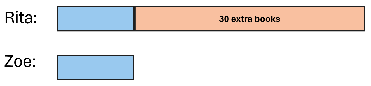
After Rita gives 8 books to Zoe, she must end up with 2 copies of everything Zoe has, including the 8 new books Zoe got from Rita. This means that Rita must keep 2 extra copies of the unit of 8 books for herself in order to end up with twice as many, and additionally, she must also keep an extra copy of the unit of books that Zoe originally had:
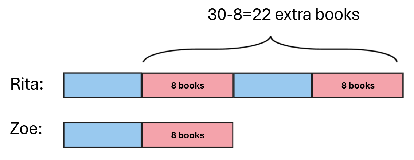
We could even take Zoe’s new extra books, and give them back to Rita to see that the 30 books represents 3 copies of the 8 books, plus 1 copy of what Zoe had originally:
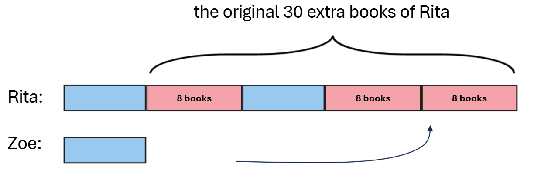
This means that if we subtract the 3 copies of the 8 books from 30 we would obtain Zoe’s original number of books:
\(30-3\times 8=30-24=6\)
This means that Rita originally had \(6+30=36\) books.
The following is a variation on the above problem where we don’t know the actual number of extra books. Instead, we are given the number of multiples which changes.
Example 2: Phil originally had 6 times as much money as Anne. After Phil gave $6 to Anne, he ended up with only 4 times as much money. How much money did Anne have?
The diagram below illustrates how Phil now has 4 copies of what Anne had (the blue unit), plus another 4 copies of the $6 unit (yellow).
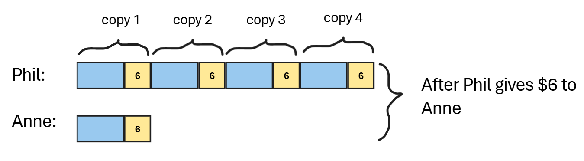
Now let’s give the $6 back to Phil, and try to draw another bar diagram trying to represent how Phil used to have 6 copies of everything that Anne had.
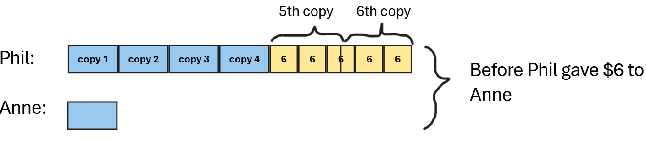
In the beginning Phil had 6 times as much money as Anne. Now, we already know that Phil has 4 copies of what Anne originally had (from the previous diagram). What about the 5th, and 6th copies? These extra copies must come from the 5 copies of the $6 which he ended up giving to Anne. This means that the 2 copies of what Anne had represents $5=$30$.
2 units = $30 $–>$ 1 unit = $15
Thus, Anne had $15.
4.2.4 Two missing values (normally solved using two equations, with two unknowns)
Example 1: An apple costs three times as much as a pear. Jessica bought 3 apples, and 4 pears, and paid $26. How much does one apple cost?
Solution: We neatly represent the cost of a single apple using 3 units of the cost of the pear. We then create 3 copies of the 3 units representing an apple (i.e. \(3\times 3=9\) units), and 4 units representing the pear.

This means that a total of \(3\times 3+4=9+4=13\) units represent the cost of 3 apples, and 4 pears, which amounts to $26. So, 13 units = $26, so 1 unit = $26/13 = $2. Thus, the cost of 1 pear is $2, so the cost of 1 apple would be $3$2 = \(6\)
To solve this problem algebraically, we introduce the following variables:
Cost of 1 apple: \(a\)
Cost of 1 pair: \(p\)
The first sentence implies that \(a=3p\), while the second sentence states that \(3a+4p=26\). Now we substitute \(3p\) for \(a\) in the second equation and solve it:
\(3(3p)+4p=26\)
\(9p+4p=26\)
\(13p=26\)
\(p=26/13=2\)
Thus, pairs cost $2, and apples cost 3 times as much, so $\(6\).
4.2.5 When two pairs are being compared to another pair
Example 1: Lily and Sara had an equal amount of money at first. After Lily spent $14, and Sara spent $22, Lily had 3 times as much money as Sara. How much money did they each have first?
Solution: The bar diagram below shows how they both started with the same amount of money, and neatly illustrates how the difference between their spending, which is $8, represents the 2 extra units that Lily had compared to Sara (after both spent their money).
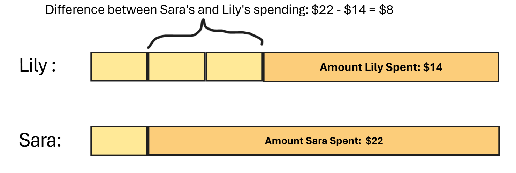
This means that 2 units = $8, so 1 unit = $8/2 = $4. Thus, they both had $4+$22= $26
4.2.6 Structural Variation for Pedagogical Impact
One of the most powerful ways elementary teachers can support student understanding of word problems is by intentionally varying problem structure—not just the numbers or context. While numerical variation (e.g., changing 6 to 6.4, or using fractions instead of whole numbers) offers opportunities for practicing computation and reinforcing number sense, structural variation allows us to scaffold student reasoning and extend their conceptual understanding.
Take for example the following classic two-step problem:
“Jose has 6 more marbles than Jessica. Together they have 18 marbles. How many marbles does Jessica have?”
This problem invites students to set up and solve a system of relationships, either through algebraic reasoning, guess-and-check, or number sense strategies. To support learning, we can develop a family of related problems that vary along two pedagogically important dimensions: numerical complexity and structural complexity.
Numerical Variation
Teachers can change the problem’s numerical features while keeping the structure the same. For instance:
Decimal context:
“Jose has 6.4 teaspoons more sugar than Jessica. Together they have 18.9 teaspoons. How much sugar does Jessica have?”Fraction context:
“Jose has \(\frac{1}{2}\) cup more than Jessica. Together they have \(\frac{5}{2}\) cups. How much does Jessica have?”
These variations support fluency with different number types while reinforcing the problem structure.
Structural Variation
We can also modify the structure of the problem in a way that introduces new reasoning challenges or focuses attention on foundational concepts. For example:
Increased complexity with more steps:
“Jose has 6 more marbles than Jessica. After Jose lost 2 of his marbles, together they ended up with only 18 marbles. How many marbles does Jessica have?”
This version now requires students to adjust Jose’s marbles before solving, introducing an extra layer of reasoning.Adding a time element:
“Jose is 6 years older than Jessica. Three years ago, their combined age was 18. How old is Jessica now?”
Although the structure is analogous, the time shift requires students to reason about the passage of time and its effect on total quantities.
Structurally Simpler Problems (Focusing on Prerequisite Skills)
Sometimes, it’s useful to simplify the structure in order to isolate and build specific reasoning skills needed for the original problem. For example:
To strengthen the idea that dividing a total evenly between two people makes sense when the amounts are equal:
“Jose has just as many marbles as Jessica. Together they have 42 marbles. How many marbles does Jessica have?”To support the understanding that a difference can be used to create equal parts: “Jose has 6 more marbles than Jessica. After playtime Jose lost a couple of his marbles. Now Jose and Jessica have the same number of marbles. How many marbles did Jose lose?”
These simpler problems allow students to rehearse specific sub-skills—such as equality, difference, or fair sharing—before tackling more complex multi-step scenarios.
Why This Matters
Strategic variation helps teachers differentiate instruction while reinforcing conceptual understanding. By tweaking problems along both numerical and structural dimensions, we can:
Scaffold struggling learners toward more complex reasoning
Provide meaningful practice beyond rote substitution
Reveal student misconceptions through focused problem types
Encourage flexible thinking and transfer across contexts
In your own teaching, consider designing problem progressions that move from simple to complex, concrete to abstract, and direct to inferential. Structure matters—not just what the numbers are, but how students must relate them. Thoughtfully varied problems build thoughtful problem solvers.
4.3 Exercises
Solve the following word problems by drawing a bar diagram, and providing a Teacher’s Solution. Either use technology to draw precise, and accurate diagrams, or use a straight-edge, and a pencil, and do your best to produce neat, and accurate diagrams. Be sure to explain your steps in complete sentences, and provide the final answer in a complete sentence, with attached units like $, cm, feet, etc.
Basic 4th Grade Word Problems
Arthur scored 258 point at a carnival game. Joel scored 84 more points than Arthur and 68 more points than Ruth. How many points did the three children score in all?
Ivan has 400 more stickers than Tom at first. He gives 300 stickers to Tom. Who has more stickers now? How many more?
300 children are divided into two groups. There are 50 more children in the first group than in the second group. How many children are there in the second group?
The difference between two numbers is 2184. If the bigger number is 3 times the smaller number, find the sum of the two numbers.
Mrs. Garcia saved $2001 in two years. She saved $65 a month in the first 15 months. She saved the same amount every month in the next 9 months. How much did she save a month in the next 9 months?
Sally had 57 more pencils than pens. After she gave away 47 pencils, she had twice as many pencils as pens. How many pens and pencils does Sally have left altogether?
A movie theater has 1210 seats. During the first movie showtime, 947 seats were taken. During the second showtime, there were 139 empty seats. How many people watched the two showtimes altogether?
Gregory has 480 stamps. Steven has 260 stamps. How many stamps must Gregory give to Steven so that they have the same number of stamps? How many stamps will each of them have after sharing?
Joey is three times as old as Jose. 4 years ago, their combined age was 40. How old is Joey now?
Mary had 1240 picture cards. She kept 80 cards for herself and gave the rest to a group of children. Each child received 8 cards. How many children were there in the group?
3000 exercise books are arranged into 3 piles. The first pile has 10 more books than the second pile. The number of books in the second pile is twice the number of books in the third pile. How many books are there in the third pile?
Provide a (i) numerically, and (II) structurally different variations to the following word problems, one being easier, tackling prerequisite skills, while another being more difficult:
Jessica has 3 times as many marbles as Jose. Together they have 32 marbles. How many marbles does Jose have?
Carlos has 7 fewer marbles than Jessica. Together they have 39 marbles. How many marbles does Carlos have?
Advanced 4th Grade Problems
Rita had 40 more barrettes than Zoe. After she gave 4 barrettes to Zoe, Rita had three times as many barrettes as Zoe. How many barrettes did Rita have left?
John and Paul spent 45 dollars altogether. John and Henry spent 65 dollars altogether. If Henry spent 6 times as much as Paul, how much did John spend?
Lily and Sara each had an equal amount of money at first. After Lily spent 21 dollars and Sara spent 37 dollars, Lily had FIVE times as much as Sara. How much money did each have at first?
The difference between two numbers is 2184. If the bigger number is 3 times the smaller number, find the sum of the two numbers.
300 children are divided into two groups. There are 50 more children in the first group than in the second group. How many children are there in the second group?
3000 exercise books are arranged into 3 piles. The first pile has 10 more books than the second pile. The number of books in the second pile is twice the number of books in the third pile. How many books are there in the third pile?
Jack and Jill had an equal number of books at first. After Jack borrowed another 20 books and Jill sold 15 books, Jack had 6 times as many books as Jill. (a) How many more books did Jack have than Jill in the end? (b) How many books did Jack have in the end?
There were 3 times as many boys as girls in a sports hall. After 75 boys left and 25 girls entered, there were 2 times as many girls as boys. If 90 children remained, how many children were in the sports hall at first?
String P is twice as long as string Q. After 75 cm of string P is cut off, string P is half as long as string Q. What is the total length of both strings at first?
One mango and one pear cost $3.30. Two mangoes and five pears cost $9.00. How much does one mango cost?
One dragon fruit is twice as expensive as a banana. 5 bananas, and 3 dragon fruit cost $3.85. What is the price of one dragon fruit?