5 Integers, Exponents, & Order of Operations
5.1 Integer Arithmetic
5.1.1 Introduction to Negative Numbers
Negative numbers have a long and somewhat contentious history, spanning centuries of mathematical development before gaining widespread acceptance. Although ancient civilizations like the Chinese had used them for bookkeeping purposes, early Arabic works on algebra did not incorporate negative values, reflecting a broader reluctance to consider them valid numbers. This hesitation persisted throughout the Middle Ages, even after algebra was transmitted to Europe. In the fifteenth and sixteenth centuries, many Italian and German mathematicians still viewed negatives as “absurd” quantities; they would dismiss a solution like x=−4x = -4x=−4 when confronted with an equation such as 7+x=37 + x = 37+x=3. Nevertheless, a growing awareness emerged that negative numbers actually simplified a range of algebraic problems. Slowly but steadily, these “unthinkable” entities found their place in the mathematical landscape, ultimately becoming just as legitimate as their positive counterparts.
In the context of elementary curriculum it soon becomes evidence that negative numbers are indispensable within the following common contexts:
Temperature Below Freezing: One of the most common ways to see negative numbers is on a thermometer. When the temperature falls below zero degrees (for instance, \(-{5}^{\circ }\)C), the thermometer must show a negative reading. This helps us measure just how far below freezing it is—an everyday situation in colder climates.
Bank Account Balance or Debt: Even at the elementary level, students learn about money. If you owe more money than you have (such as borrowing lunch money from a friend), your “balance” can be thought of as negative. For example, if you have $2 and spend $5, your balance is now −$3 because you’re 3 dollars short.
Elevations Below Sea Level: When talking about geography, certain places lie below sea level. The Dead Sea region, for instance, is about 430 meters below sea level, often represented as −430 meters. Using negative numbers in this context highlights the depth beneath the “zero” reference (sea level) and is a clear, real-life application of negative values. The vector model for integers (see below) will be used to do arithmetic in the context of hiking up or down in elevation.
Example 1: Suppose a hiker is located at -17 meters below see level. After hiking for several hours he ends up rising about 34 meters in elevation. What is his current elevation?
Solution: His current elevation is \(-17+34\ =\ 17\) meters
Models for the Integers
The integers can be represented using three different models:
Number Line Model
Representation: Integers are placed in a sequence of equally spaced points along a horizontal line, with negative numbers extending to the left of zero and positive numbers to the right.
Key Features:
- Ordering is intuitive: “less than” corresponds to “being farther to the left.”
- Distance on the line relates to magnitude.
Addition & Subtraction:
- Adding a positive number means moving right; adding a negative number means moving left.
- Emphasizes ordinal and spatial aspects of integers.
Vector (Movement) Model
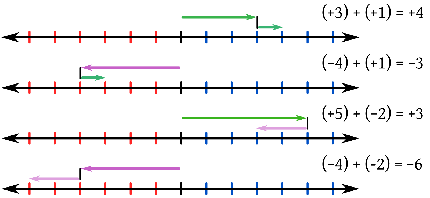
Representation: Integers become “moves” or “jumps” along a line, focusing on direction (left or right) and magnitude (the number of units).
Key Features:
- Treats all subtraction as “adding the opposite.” Thus, we will rewrite \(5\ -\ 2\ =\ 5\ +\ (-2)\). This is a key method for teaching addition, subtraction of integers, especially when dealing with complex algebraic expressions in 6th grade.
- Positive jumps go to the right; negative jumps go to the left.
Addition & Subtraction:
- Direct interpretation of operations as consecutive moves.
- Provides a dynamic view of operations, especially helpful for understanding integer arithmetic rules (e.g., why −3−4=−7-3 - 4 = -7−3−4=−7 can be seen as two consecutive leftward jumps).
Chip Model

Representation: Uses two-colored chips—typically one color (white) for positives and another color (red) for negatives.
Key Features:
- Positive and negative chips cancel out when paired.
- Visually shows how combining positives and negatives can lead to a net effect.
Addition & Subtraction:
- To add 3 + (−5)(-5)(−5), place 3 white chips and 5 red chips; 3 pairs annihilate each other, leaving 2 red chips (i.e., −2-2−2).
- A concrete, “hands-on” model, often favored in elementary and middle grades to visualize integer sums.
Money Model
Representation: Interprets positive integers as amounts of money “on hand” and negative integers as amounts “owed” (debt).
Key Features:
- Connects directly to real-life situations of earning, spending, and going into debt.
- Helps students understand negative as something to be “paid back.”
Addition & Subtraction:
- 3 + (−5)(-5)(−5) means having $3, then needing an extra $2 (borrowed) to pay for a $5 purchase, leaving you with a debt of $2 (i.e., −2-2−2).
- Reinforces the concept of net balance (positive or negative).
5.1.2 Definitions, Properties & Arithmetic with Integers
Properties of Integers
Property 5.1.1: The opposite of a positive integer is the negative version of that integer while the opposite of a negative integer is the positive version of that integer. To express the operation of “taking the opposite” we place the negative sign at the front: \(-(5+3)\) means “take the opposite of the sum of 5, and 3). Thus, the negative sign “\(-\)” is both an operation (a verb), and an attribute (adjective) describing the number noun.
Example 1: What is the opposite of \(-17\)?
Solution: The opposite of \(-17\) is 17.
Property 5.1.2: The associative, and commutative properties hold for addition, and multiplication of integers. This is more like an axiom that mathematicians have accepted about negative numbers. Since the positive integers have enjoyed these properties for the sake of consistency it was important to have the negative integers also hold these properties.
Property 5.1.3: The product of an integer \(a\) and \(-1\) is the opposite of \(a\). Thus multiplying any algebraic expression by \(-1\) is the same operation as taking the opposite, which also corresponds to placing the negative sign ‘$-’$in front of that expression.
Example 2: \((-1)(2-5)\) gives the same result as the opposite of \((2-5)\), which can also be represented \(-(2-5)\).
Property 5.1.4: The absolute value of an integer \(a\) is written \(|a|\), and it is the positive distance of \(a\) from 0.
Property 5.1.5: To add two negative integers we take the opposite of the sum of their absolute values.
When adding integers $a,\ b$ of mixed parity (i.e. say $a$ is positive while $b$ is negative), we consider two cases:
Case 1: \(|a|\geq |b|\), then \(a+b=a-b\).
Case 2: \(|a|<|b|\), then \(a+b=\) \((-1)(|b|-a)\).
Property 5.1.6: When adding two negative integers \(a\) and \(b\), we simply add their absolute values, and the result is the opposite of the sum: \(a+b=-(|a|+|b|)\)
Property 5.1.6: Subtraction is the same as adding the opposite, or equivalently, adding \((-1)\) multiplied by the subtrahend.
Example 2: $17-23 = 17 + (-23)=-(23-17) =-6$
Property 5.1.7: Multiplying a positive integer by a negative integer is understood in terms of repeated addition:
\(4\times (-3)=(-3)+(-3)+(-3)+(-3)=-(3+3+3+3)=-12\).
Thus, a positive integers multiplied by a negative integer results in a negative integer.
Property 5.1.8: To compute the product of a negative integer and a positive integer we first apply (the stipulated, no proven) commutative property of multiplication for integers, then use latter property to compute the product:
\((-7)\times 3\ =\ 3\times (-7)=(-7)+(-7)+(-7)=-(7+7+7)=-21\)
Property 5.1.9: The product of two negative numbers is the same as the product of their absolute values.
Proof: The key to understanding the product of two positive integers is the application of the distributive property. Suppose we don’t know how to compute the product of two negative numbers, and we need to compute \((-3)\times (8-4)\). We can do the latter in two ways.
Method 1: Applying Order of Operations, the commutative property of multiplication, and Property 5.1.7
\((-3)\times (8-4)=(-3)\times 4=4\times (-3)=12\)
Method 2: Applying the distributive property:\((-3)\times (8-4)=(-3)(8+(-4))=(-3)\times 8+(-3)\times (-4)=\ -24\ +\ ?\)
Since the two methods should in theory produce the same result, we have the following equality:
\(12=-24\ +\ ?\)
This implies that the question mark should be positive 12, implying that
\((-3)\times (-4)=12=|-3|\times |-4|\).
Thus, we are forced to admit (lest we introduce inconsistencies in transitioning from the whole numbers to the integers) that the product of two negative numbers must be the absolute value of their products.
The various meanings of the subtraction symbol \(-\)
In integer arithmetic, the symbol “–” can serve three different roles. First, it can modify a whole number to indicate its negative attribute (for example, “–7” means 7 units below zero). Second, it can denote the classic subtraction operation that finds the difference between two integers (for instance, “10 – 3 = 7”). Finally, it can serve as an operator that takes the opposite (or “negates”) a given integer (so “–(4)” flips 4 to –4, and “–(–4)” flips –4 back to 4).
5.2 Rules of Exponents & Order of Operations
5.2.1 Exponents, and Rules
Definition: The meaning of \({a}^{n}\) is the product of \(a\) n times. Here \(a\) is called the base while \(n\) is called the exponent.
Definition: The expanded form of \({3}^{5}\) is \(3\times 3\times 3\times 3\times 3\)
Suppose we are multiplying \({3}^{2}\times {3}^{4}\). We can rewrite each exponential expression in expanded form:
\({3}^{2}\times {3}^{4}=(3\times 3)\times (3\times 3\times 3\times 3)=3\times 3\times 3\times 3\times 3\times 3={3}^{6}={3}^{2+4}\)
Since the multiplication is associative, we can drop the parentheses, and rewrite the expanded multiplication expression in condensed exponential form. This gives us:
The Product Rule: \({a}^{m}\times {a}^{n}={a}^{m+n}\)
In a similar fashion, if we are dividing two exponential expressions, we would rewrite them both in expanded form, then divide each base whole number in the numerator by its corresponding copy in the denominator:
\({3}^{5}/{3}^{2}=\frac{3\times 3\times 3\times 3\times 3}{3\times 3}=\frac{3\times 3\times 3}{1}={3}^{3}={3}^{5-2}\)
We notice that the resulting exponent is the difference of the two original exponents, giving us:
The Quotient Rule: \({a}^{m}/{a}^{n}={a}^{m-n}\)
Now, suppose we have an exponential expression, and we are raising this expression to new power such as raising \(({7}^{2})\) to the power of 3. We begin by rewriting the expression in an expanded form
\({(7}^{2}{)}^{3}=({7}^{2})\times ({7}^{2})\times ({7}^{2})\)
Power of the Power Rule: \(({a}^{m}{)}^{n}={a}^{mn}\)
Power of the Product Rule: \((a\times b{)}^{n}={a}^{n}\times {b}^{n}\)
Power of the Quotient Rule: \((a/b{)}^{n}={a}^{n}/{b}^{n}\)
Theorem 5.2.1: 0 as a Power Rule: Suppose \(a\ne 0\), then \({a}^{0}=1\)
Proof: Suppose \(a\) is a nonzero number, then by the Quotient Rule it follows:
\({a}^{0}={a}^{1-1}={a}^{1}/{a}^{1}=a/a=1\)
5.2.2 Order of Operations
Introduction
Mathematics is filled with powerful ideas, yet many of the things we do in mathematics are grounded in conventions—agreements that people collectively adopt for clarity and consistency. The order of operations is a prime example. When we see an expression such as \(2+3\times 4\), we have all been trained to perform the multiplication before the addition, resulting in\(2+12=14\). But why do we do that, and is there a deeper, unbreakable law of mathematics dictating we must always multiply before adding? The short answer is no. The rule about multiplying before adding does not emerge from a fundamental truth about numbers themselves; rather, it is simply a convention that ensures everyone interprets expressions in the same way.
If we did not follow a common order of operations, the same mathematical expression could yield different results depending on the interpreter. This section explores these conventions in detail, focusing on how they work with integer arithmetic. We will start by examining the well-known acronym PEMDAS, discuss why it could also be PEDMSA, and then illustrate how these rules apply to real examples.
Why We Need a Convention
Consider the expression \(8-2+5\). If you read from left to right, you might perform \(8-2=6\) first, then add 5 to get 11. Another person might instead see the same expression and decide to group it as \(8-(2+5)=1\). If no standard convention existed, either result might seem valid. To avoid confusion, mathematicians, scientists, and educators agreed on a standard method of reading and simplifying expressions. That way, an expression such as \(8-2+5\) unambiguously evaluates to \((8-2)+5=11\).
This standardization is helpful, but remember that it is nothing more than a shared agreement. It is not a natural law. You will, however, find that the entire structure of modern written mathematics and technology tools (like calculators and computer algebra systems) is built around these guidelines, making them indispensable for effective communication.
PEMDAS (or PEDMSA)
You have likely come across the acronym PEMDAS, often recited as “Please Excuse My Dear Aunt Sally.” It stands for:
- Parentheses
- Exponents
- Multiplication
- Division
- Addition
- Subtraction
While this acronym is extremely common, it can also be somewhat misleading because it suggests a strict order among multiplication and division (and among addition and subtraction). In reality, multiplication and division are at the same level of precedence, so you perform them in whatever order they appear from left to right. The same applies to addition and subtraction.
Hence, some educators prefer rewriting the acronym to PEDMSA, or even writing PEMDAS with a slash—for example, “PEM/DA/S”—to remind us that:
- Multiplication does not take priority over division; do whichever appears first from left to right.
- Addition does not take priority over subtraction; again, do whichever appears first from left to right.
The correct hierarchy, then, looks like this:
- Parentheses (or other grouping symbols, such as brackets)
- Exponents
- Multiplication and Division (left to right)
- Addition and Subtraction (left to right)
Parentheses/Grouping Symbols
Evaluate whatever is inside parentheses (or brackets) first. If there are nested parentheses, start from the innermost group. This step also includes other grouping symbols you might see, such as braces \(\{\ \}\) or fraction bars, which act like a built-in grouping.
Exponents
Evaluate powers, such as \({a}^{b}\), next. This includes roots and other notations that represent exponentiation.
Multiplication and Division (Left to Right)
Treat multiplication and division as having equal importance. Scan from left to right, performing these operations in the order they appear. For instance, in \(12\div 3\times 4\), do \(12\div 3=4\) first, and then multiply by 4 to get 16. If you reversed the order (multiplying first), you would wrongly get 12÷12=1.
Addition and Subtraction (Left to Right)
Finally, treat addition and subtraction in the same way, proceeding from left to right. In an expression like \(8-3+2\), start with 8−3=5, then add 2 to get 7. Doing it in a different order, such as 3+2=5 then 8−5=3, would give a different answer, which the standard convention regards as incorrect.
Example 1: \((2+3)\times 4\)
Solution: First add 2, and 3 obtaining 5, then multiply the result by 4 to get 20.
Example 2: \(({3}^{2}-1)+5\)
Solution: We have three operations here: exponentiation, subtraction, and addition. We first compute \({3}^{2}=9\), then we subtract 1 \(9-1=8\), and finally add 5: \(8+5=13\).
Common Pitfalls
- Forgetting the Left-to-Right Rule: Many mistakes happen when a student sees multiplication and division in the same expression and assumes multiplication always goes first. This is incorrect.
- Ignoring Parentheses: Sometimes, it is tempting to jump straight to exponents or to perform addition before addressing what is inside parentheses. Always remember that parentheses (or other grouping symbols) override everything else.
- Misinterpreting Negative Signs with Exponents: While not strictly about order of operations with integers, an expression like \(-{3}^{2}\) can be confusing. The exponent applies to 3 first, then the negative sign is effectively multiplied afterward, so \(-{3}^{2}=-({3}^{2})=-9\). But \((-3{)}^{2}=9\). Parentheses change the meaning!
5.2.3 Teaching of Integers per California Common Core Standards
In Grade 6, the California Common Core State Standards for Mathematics (CA CCSSM) introduce integers and their properties as foundational concepts. Students begin by understanding that positive and negative numbers are used to describe quantities with opposite directions or values, such as temperature, elevation, and financial balances, and they explore the meaning of zero in these contexts (6.NS.5). They extend their understanding of the number line to include negative numbers, learning to plot and interpret integers on both horizontal and vertical axes, as well as recognizing symmetry and opposites on the number line (6.NS.6). Students also compare and interpret the absolute value of integers in real-world scenarios, using inequalities and understanding relative positions and distances on a number line (6.NS.7). Additionally, students apply these concepts to solve mathematical and real-world problems involving graphing points in all four quadrants of the coordinate plane, incorporating the properties of integers to calculate distances between points (6.NS.8). These standards provide students with a comprehensive introduction to integers, establishing a strong mathematical foundation for more complex concepts in higher grades.
5.3 Exercises
How does the California curriculum address the teaching of operations with integers, such as addition and subtraction, and what role does the use of number lines and real-world contexts play in this instruction?
Illustrate the following sums using (a) the vector model, and (b) money model, and (c) the chip model.
- \(6+(-4)\)
- \((-11)+(-13)\)
- \(6+(-4)\)
How many pairs of opposite integers are there between \(-4\) and \(5\)? Which ones?
Identify the smallest negative integer larger than \(-7\).
Determine whether the following statement is true or false. If it’s false provide a counterexample.
- Every integer is a natural number
- The sum of two negative numbers is positive.
- The sum of a positive number, and a negative number is a positive number.
- The product of two negative numbers is a positive number.
- When adding two negative numbers we add their absolute values, then take the opposite of the result.
- The opposite of an integer is the same as its positive version.
- When we multiply an integer by -1, this gives us the same result as finding its opposite.
- When dividing a positive number, and a negative number we get a positive number if the dividend is larger than the divisor.
- Every integer is a natural number
What are the three different meanings of the symbol \("-"\) within integer arithmetic?
Create a word problem using the following operations, and their corresponding models:
- \(-17+49\) using the vector model
- \(125\ +\ (-37)\) using the money model
- \(-19+\ (-17)\) using the money model
- \(-17+49\) using the vector model
A student things that \(|a|=-a\) is true only when \(a=0\). Explain why the student is mistaken, and what is the specific misconception that they have?
Use the vector model to verify the following identities:
- \(a+(-a)=0\)
- \(-(a+b)=-a-b\)
- \(a+(-a)=0\)
Evaluate the following expressions when \(x=10\), \(y=-8\), \(z=3\)
- \(-(-12)+z/7\)
- \(-x-(-y)-14\)
- \(-(-12)+z/7\)
Evaluate the following expression: \(-(-1{)}^{3}-{1}^{4}-{1}^{3}+(-1{)}^{100}\)
Evaluate the following expression when \(a=-2\): \(-(-a{)}^{3}-(a-{{a}^{4})\div a}^{}\)
Fill in the blanks using the operators \(+,\ \div \ \times ,\ -\)
- \({6}^{3}\)___ \(3\) ___ \(21\) ___ \(3=135\)
- \(12\)___ \((24\) ___ \(6{)}^{3}=76\)
- \(9\)___ \(12\)___ \({7}^{2}=59\)
- \({6}^{3}\)___ \(3\) ___ \(21\) ___ \(3=135\)
Suppose \(a\) is a positive number and \(b\) is a negative number (so neither is zero). State whether the following are positive or negative.
- \(ab\)
- \(-ab\)
- \(-{a}^{2}{b}^{2}\)
- \((ab{)}^{2}\)
- \(-a\div b\)
- \(-|a-b|\)
- \({b}^{n}\) and n is an even whole number
- \({b}^{n}\) and \(n\) is an odd whole number
- \(ab\)
Simplify the following in a fraction with all the exponents being positive:
- \(\frac{{6}^{3}\cdot {3}^{6}\cdot {8}^{-2}}{1{0}^{-3}\cdot 1{5}^{4}}\)
- \(\frac{3{6}^{4}\cdot {6}^{-4}\cdot 9{6}^{-3}}{4{8}^{-2}\cdot 1{5}^{2}\cdot 256}\)
- \(\frac{{6}^{3}\cdot {3}^{6}\cdot {8}^{-2}}{1{0}^{-3}\cdot 1{5}^{4}}\)
Simplify the following expressions mentally, but write down the steps you used:
- \((23+26+(-13))\cdot 25\)
- \((6+(-17)+(34+(-13))\)
- \((4+2\cdot (113-(-7)))\div 4\)
- \(-6\cdot (8-20)\cdot 15\)
- \(263-(4\cdot (-15))-(-130)\)
- \(((-84+76)\cdot 50)-94\)
- \((-97+113)\div (18+(-14))\)
- \((52-((9-22)\cdot 2))\cdot 4\)
- \(5z+(-2z)-(2z(62+(-57))\)
- \({x}^{2}-(-y)+(-x)(x+(-{y}^{2}))\)
- $((x-y)(y+x))-(-{y}{2}+{x}{2})$
- \((23+26+(-13))\cdot 25\)