3 The Models and Interpretations of the Four Binary Operations
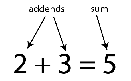
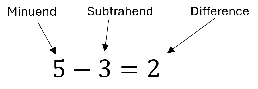
3.1 Addition & Subtraction
3.1.1 Definition of Addition, and Subtraction
Subtraction and addition are interrelated in the following sense. Suppose we are trying to understand the meaning of 5-3, we would interpret it as the number which when added to 3 gives you 5. Thus, the difference added to the subtrahend should give you the minuend. Thus, \(17-8\) is defined as the number that fits in the blank:
\(8+\) ______ \(=\ 17\)
Children should begin seeing the relationship between addition and subtraction using number bonds:

The number bond above may also be represented on a ten-frame as follows:
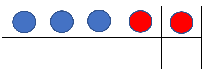
Both the number bond and the ten-frame represent the relationship between 2, 3, and 5: they indicate that 2 and 3 combined give you 5. However, they also illustrate the following additional facts:
The Four Fact Family for Addition & Subtraction, illustrating the number bond 5 - 2,3.
| 3 + 2 = 5 | 2 + 3 = 5 |
|---|---|
| 5 - 2 = 3 | 5 - 3 = 2 |
The four-fact family illustrates several aspects of addition and subtraction. It first incorporates the commutative property of addition. Secondly, it illustrates the deeper connection between addition and subtraction, showing how the two are really two sides of the same coin. Children should be given several exercises where they would be given one of the facts, and asked to fill-out the rest of the facts as follows:
Example 1: Find the missing facts:
| \(7+4=11\) | |
|---|---|
Solution:
| \(7+4=11\) | \(4+7=11\) |
|---|---|
| \(11-7=4\) | \(11-4=7\) |
Example 2: Find the missing facts:
| \(73-16=\ 57\) |
Solution:
| \(57+16=73\) | \(16+57=73\) |
|---|---|
| \(73-57=16\) | \(73-16=\ 57\) |
Children may also be presented with a ten-frame involving two colors and asked to identify the corresponding number bond, or corresponding four-fact family, or vice-versa.
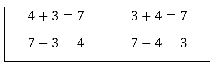
Example 1: Identify the number bond, and the four-fact family based on the ten-frame pattern:

Solution:
 |
 |
|---|
3.1.2 Fostering the Place-Value Process
Place-value systems are a fundamental part of how we represent and understand numbers today, and as we observed in chapter 2, they have a rich history that spans many cultures and centuries. A place-value system is one in which the position, or “place,” of a digit within a number determines its value. The most familiar place-value system is the base-10 (decimal) system, which we use in everyday life, but various civilizations have used other bases throughout history, such as base-60 by the ancient Babylonians and base-20 by the Maya.
The Indian mathematicians of the Gupta Empire (circa 4th-6th centuries CE) developed the base-10 place-value system, which later spread to the Islamic world and Europe. This innovation, combined with the introduction of the digit zero, revolutionized mathematics and laid the foundation for the modern number system.
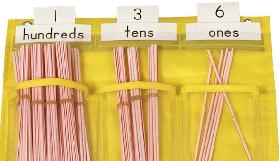
To teach first graders about the base-10 system using sticks and bundles, you can use the following approach:
- Introduce the Sticks (straws would do as well): Begin by showing the children individual sticks. These sticks represent ones. Explain that each stick is a single unit or one. Let them count small numbers of sticks (up to 9) to become familiar with the idea that each stick stands for one.
- Create Bundles: Once they understand counting individual sticks, introduce the idea of bundling. When you have 10 sticks, tie them together to form a bundle of 10. Explain that this bundle represents a higher value, specifically “ten.” This is the first denomination. So, now instead of counting 10 individual sticks, you can say you have 1 bundle of 10.
- Larger Bundles and Denominations: Next, tell the students that we can continue bundling as we get more sticks. For example, when we have 10 bundles of 10 (which is 100 sticks in total), we can place these bundles into a new, larger container called a denomination for hundreds. This container holds 10 bundles of 10 sticks. Now you have a container that represents 100, just as the bundle represents 10.
- Limit the Bundles per Denomination: Emphasize that each denomination can hold at most 9 bundles. So, in the “tens” denomination, you can have between 0 and 9 bundles of ten sticks. In the “hundreds” denomination, you can have between 0 and 9 bundles of 100 sticks.
- Counting the Bundles: To determine the total number represented, show how we count the bundles in each denomination. First, count how many bundles are in the ones place (loose sticks), then count how many bundles are in the tens place, and if there are more bundles, count how many are in the hundreds place.
- Adding Up the Values: Finally, add together the values of the bundles from each denomination. For example, if you have 3 bundles of 100, 4 bundles of 10, and 7 individual sticks, explain that the number is 347 (3 hundreds + 4 tens + 7 ones).
This hands-on method helps first graders visually and tangibly understand the concept of place value and the base-10 system by organizing the sticks into bundles and denominations that represent increasing powers of ten.
 |
 |
|---|
Here are several strategies to fostering the base-10 place-value system:
- Counting by tens: “10, 20, 30, 40,…” This shows, for example, that counting by tens (in base 10) is far easier than counting by 9. We just need to count the bundles of tens.
NOTE: In Quinary, counting by 5s would also be easy: \((10{)}_{5},\ (20{)}_{5},(30{)}_{5},...\)
- Adding tens: “What is one decade after 49?” “What is 59+10”. This teaches rebundling.
- What number is 30 more than 349? The answer requires adding 3 bundles of ten to the 4 bundles already present in the first addend.
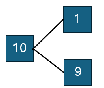
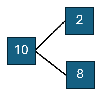
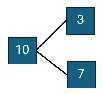
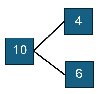
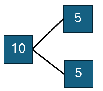
The idea of number bonds can be extended early in teaching the base - 10 system of the Hindu-Arabic number system. The idea is that 10 can be decomposed in several ways into two smaller numbers. Each of these number bonds, of course yield their corresponding 4-fact families, which should be mastered:
 |
 |
 |
 |
 |
|---|
3.1.3 The Chip Model:
The most important model for fostering the place-value process is the chip-model:
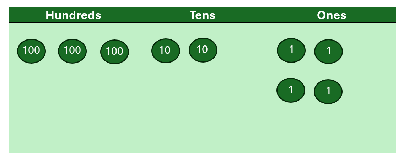
In the chip model depicted above, we have the number 324 represented using labeled chips placed under their corresponding denomination. Initially when children are exposed to the chip model it’s a good idea to have these chips labeled based on their place-value. However, in time, the labelles should be removed so that the value of each chip is ultimately determined by its placement, and not by its label. This corresponds to the idea that digits do not change their representation when moving from one place to another. Thus, the ‘3’ in 3421 and the ‘3’ in 4203 still look like a 3 but each of them has a different value derived from their place.
Finally, numbers should be written in expanded form in order to foster the idea of the summation of different denomination:
3421 = 3000 + 400 + 200 + 1
The same can be done in other bases. For example in Quinary \((3000{)}_{5}\) represents 3 copies of \({5}^{3}=125\), while \((200{)}_{5}\) represents 2 copies of \({5}^{2}=25\); \((10{)}^{5}\) represents 1 copy of \({5}^{1}=5\), and finally the \((4{)}_{5}\) simply represents 4 copies of \({5}^{0}=1\):
\((3214{)}_{5}=(3000{)}_{5}+(200{)}_{5}+(10{)}_{5}+(4{)}_{5}\)
3.1.4 Models for Addition, and Subtraction
Addition is an operation which combines two numbers called addends, or summands to form a third number called the sum. Addition can be represented in many different contexts, and representations called models. The set model applies to discrete cases, the measurement model applies to continuous quantities, while the number-line model applies to cases involving ordered quantities such as temperature, elevation, map positions, etc.
Set Model
This is a discrete model where students can count using their fingers, and compute the addition problem such as 3+4 = 7





Measurement Model:
The measurement model will use continuous quantities which will generally be
representing using units of measurement such as meters, kilograms, pounds, dollars. These are generally more difficult to grasp for children in 1st and 2nd grades, and are confined to grades 3 or above.
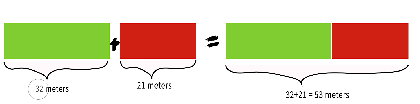
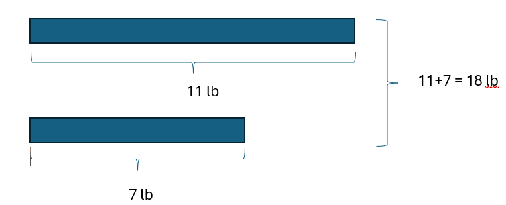
Bar, or strip diagrams are often used to represent the measurement model. So addition of two
quantities may be represented this way. One method would be to place the strips next to each other horizontally:
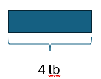 |
\(+\) | 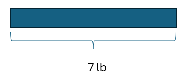 |
\(=\) | 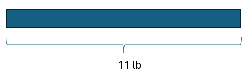 |
|---|
Or you can represent this addition vertically as will often be the case in solving word problems:
Number-Line Model
In contrast the number line model uses the idea of starting with the first addend, then moving toward the right or left depending on whether we are adding or subtracting. When adding a positive number we move the corresponding number of steps to the right, whereas when adding a negative number or when we subtract we move to the left.
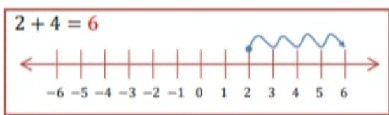
Here is another style of representing addition of integers using a number line. Here we always start from 0, so the first addend already represents the operation of moving to the right (or left depending on whether we’re starting with a negative number), and then moving in the corresponding direction based on the sign of the second addend.

What is unique about the number-line model is that (unlike in the case of the set and measurement models) the addends represent different kinds of things. The first addend represents a position, a location on the number line, whereas the second addend represents the number of jumps. Similarly, in subtraction the minuend is a location while the subtrahend is a number of steps to the left. Finally, it’s important to note that the number-line model is indispensable when introducing integer arithmetic.
3.1.5 Interpretations of Subtraction
In the Take-Away Interpretation we remove the objects from a set of decrease a measurement by an amount specified by the subtrahend.
| Set Model Example | Measurement Model Example |
|---|---|
| Jose has 24 marbles. He gives 7 marbles to his friend. How many marbles does Jose have now? | Jessica had $27. She spent $9 on a book. How much does she have left? |
For the Part - Whole Interpretation a part (the subtrahend) of a total set (the minuend) of quantities is specified, and we must determine the missing component (the difference) in order to make it a whole.

| Set Model Example | Measurement Model Example |
|---|---|
| Jose has 24 blue and green marbles. If 7 of his marbles are blue, how many are green? | Jessica spent $27 on book, and pencils. If she spent $13 on books, how much money did she spend on pencils? |
In the Comparison Interpretation we are comparing two different sets of measurements. The minuend represents one of the quantities while the subtrahend represents the other. The difference is the amount by which one quantity is more numerous or fewer than the other.
 | Set Model Example | Measurement Model Example |
|---|---|
| Jesse has 4 toy cars, while Juanita has 8 toy cars. How many fewer toy cars does Jesse have? | Helena made a punch by mixing 3 cups of orange juice, and 7 cups of apple juice. How many more cups of apple juice did she use? |
The comparison interpretation may also be represented using bar diagrams, which will be ubiquitous in chapter 4 when we begin to solve word problems. In the meantime, here’s an example of representing \(10-4\) using a bar/strip diagram:
3.1.6 Thinking Strategies for Addition, and Subtraction: Learning Addition within 20
Addition within 20 refers to the ability to add two addends where the sum is no more than 20. This ability is critical for the addition as well as the subtraction algorithm in base-10. The reason for this is that within the context of addition we will primarily be adding digits, i.e. number 0, 1, 2, 3, 4, 5, 6, 7, 8, 9, and in the context of subtraction 18 would be the largest minuend and 9 the largest potential subtrahend.
Thinking strategies for learning addition within 20
| Thinking Strategy | Example | Explanation |
|---|---|---|
| Adding +1, +2 | \(7+1=8\) | This is basically the counting-on strategy, which children know how to do by simply counting from 1. So, they would know that \(7+1=8\) because they would count up from 7 and discover that the next number is 8. |
| Adding +0 | \(7+0=7\) | This is easy to understand once taught |
| Applying Commutative Property: | \(3+9=9+3\) | Children may struggle with \(3+9\) especially if they tend to use counting-on as their primary strategy. The Commutative Property helps in converting the problem \(3+9\) into \(9+3\) where the commutative property can now be used. |
| Doubles | \(2+2\), \(3+3\), \(4+4\) | This is a set of facts that need to be memorized |
| Adding 10 | \(5+10=15\) | This strategy would be taught once the notion of placed-value is more clear |
| Tens Combinations | \(5+5=10\) \(6+4=10\) \(7+3=10\) \(8+2=10\) \(9+1=10\) | These facts would be taught, and memorized, especially in conjunction with ten-frame diagrams. |
| Relating to Doubles | \(6+7=\) \((6+6)+1=\) \(12+1=13\) | Once the doubles strategy is mastered, the Relating to Doubles strategy would be a great way to learn to do mental math |
| Compensation | \(9+5=10+4\) | This is a general strategy which could be employed for larger numbers. One of the addends simply passes a 1 or a 2 to the other addend, thereby converting it to a multiple of 10. This reduces the problem to the Adding 10 strategy. |
Thinking strategies for performing subtraction
Four-Fact Families and Number Bonds
**Example**: Since we know that $19+37=56$, we could infer that $56-37=19$Explanation: The four-fact family strategy is not merely useful in learning addition and
subtraction within 20, but also for larger number, and even in algebraic expressions. For
example, since \(3x+7=19\), it follows that \(3x=19-7\). This is still the principle derived from the four-fact family of \(3x\), \(7\), and \(19\).
Regrouping the Minuend Classic (The Classic Subtraction Algorithm)
**Example**:  $37\ -\ 19\ =\ (30+7)-(10+9)=(20+10+7)-(10+9)=$
       $=(20+17)-(10+9)=20+17-10-9=$
$=\ 20-10+17-9=10+8=18$Explanation: The above example looks a bit convoluted because most of us are acquainted with
the vertical version of the above addition problem:
The horizontal version of the Regrouping the Minuend Classic algorithm indicates that the method involves breaking the minuend \(37\) into \(20\) and \(17\). The same is indicated in the vertical version. The more thorough explanation of the subtraction algorithm will be discussed in section 3.1.8.
Counting Down
**Example**: $9-1=8$Explanation: This is a subtraction version of the counting up strategy mentioned above. The
first graders would be able to perform this strategy due to the ability to count down from 9.
Counting Up or Adding Up from the Subtrahend
Example 1: \(37-35=\)____ → \(35,\ 36,\ 37\) → \(35+2=37\) → \(37-35=2\)
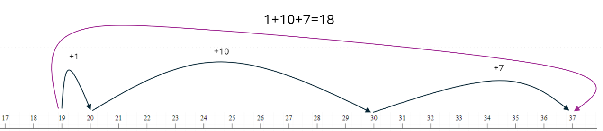
Example 2: \(37-19\ =\) ____ → \(19+\) ____ \(=\ 37\) → \(19+1+10+7=37\) → \(1+10+7=18\)
Explanation: Counting Up from the subtrahend is the reverse version of counting down.
Instead of performing $37-35$directly, we begin to count up from 35, and count how many steps it takes to get to 37. Since it’s two steps, the answer is 2. This strategy works when the subtrahend is almost as large as the minuend.
When the subtrahend is a lot smaller than the minuend (as in $37-19$), the counting up strategy may not work, but using a number line, and counting the units of jumps from the
subtrahend will help:
Compensation
**Example 1**:  $37-19\ =\ (37+1)-(19+1)=38-20=18$

**Example 2: $394-203=(394-3)-(203-3)=391-200=191$**Explanation: The compensation for subtraction does not work in the same way as addition. Here we either add or take away the same amount from the minuend and the subtrahend with the aim of obtaining a multiple of a power of 10 for the subtrahend.
Regrouping the Subtrahend
**Example**:  $397-168=\ 397-7-60-100-1=390-60-100-1=$
$=\ 330-100-1=230-1=229$ Explanation: Regrouping the subtrahend is perhaps the most innovative of the thinking
strategies in our list. It involves breaking up the subtrahend according to the easiest step-by-step subtraction operations that can be performed based on the minuend. Thus, since the ones digit in 397 is 7, we break the subtrahend 168 into 7, 60, 100, and 1. We leave the 1 toward the end because we need to take care of the tens and hundreds places first.
Regrouping the Minuend into Three Components
**Example**: $53-26=(40+10+3)-(20+6)=(40-20)+(10-6)+3=$
$=20+4+3=27$Explanation: This is a variation of the classical subtraction algorithm. In the classical case (see above, or below for the more thorough treatment) the minuend is broken only into two components: \(53=40+13\) in order to allow the subtraction of the larger ones digit \(6\) in the subtrahend. In this variation, the minuend is broken into three components: \(40+10+3\) because subtracting \(6\) from \(10\) is simply easier than subtracting it from \(13\). This methodology is also discussed in Knowing and Teaching Elementary Mathematics by Liping Ma where Chinese teachers describe the two ways the minuend can be decomposed (or regrouped).1
3.1.7 Properties of Addition and Subtraction
Addition has many properties that must be learned in school: the identity element, commutativity, and associativity. Subtraction only has the first of these properties, namely subtracting 0 results in the minuend.
Commutative and associative properties emphasize different aspects of addition. Commutativity is about the order of the summands, and this can be understood especially using the discrete set model by rearranging the summands in terms of their position as first or second summand. Associativity is about the order of the operations: it states that the order of successive addition does not matter. This is a harder to understand concept, and can be illustrated again using the set model. It is notable that the number-line model is a poor illustrator of both the associative, and commutative properties because the first summand has a specific meaning, namely the location where the addition starts.
The Identity Element: e.g. \(7+0\ =\ 7\)
Commutativity (Any-order property): e.g. $7+9\ =\ 9\ +\ 7$Associativity: e.g. \((3+7)+6\ =\ 3\ +\ (7+6)\)
3.1.8 The Classic Addition Algorithm
Introduction to the Algorithms for the Four Binary Operations
An algorithm is a step-by-step procedure or set of rules that outlines how to perform a specific task. In mathematics, algorithms form the foundation for understanding and carrying out basic operations such as addition, subtraction, multiplication, and division. For elementary school students, learning these algorithms is crucial as they provide a structured way to approach problems systematically, allowing students to gain a deep understanding of the underlying mathematical concepts.
Understanding the logic behind each algorithm is essential, not just for students but also for teachers. When teachers grasp the step-by-step logic of an algorithm, they are better equipped to explain the process in ways that make sense to young learners. For example, teaching subtraction using the algorithm of “borrowing” (or “regrouping”) requires the teacher to clearly explain why we exchange a higher value unit (like tens) for lower value units (like ones). Mastery of these explanations is critical for fostering mathematical comprehension rather than mere memorization of steps.
While modern calculators and computers can quickly perform these operations, this does not diminish the importance of teaching algorithms. The purpose of learning to subtract, say, 37 minus 19, isn’t solely to find the difference. The true aim is to understand the logic involved: how numbers are composed of digits with place values, how to exchange values between those places when necessary, and how to match digits of like places in subtraction. This logic is foundational to all higher mathematical thinking. It helps students develop number sense, a critical skill that will support them in solving more complex problems in the future.
In essence, the role of teaching these algorithms is not about arriving at the correct answer using a machine, but about building a deep, conceptual understanding of how numbers and operations work. By guiding students through these logical processes, teachers help them internalize a methodical approach to problem-solving, which is invaluable across all areas of learning.
The Prerequisites and Foundational Ideas behind the Addition Algorithm
The logic behind the addition algorithm is that digits in their corresponding place values are added, and any values equal to 10 or larger are bundled and moved to a higher place. The mastering of this logic inherently requires several prerequisites:
- Good acquaintance with place-value ideas: The 3 in \(324\) represents 3 hundreds
- Understanding numbers in their expanded form: \(324=300+20+4\)
- Mastery of 1-digit addition
- Understanding of bundling and exchanging the bundle for a higher value unit
The following exercises illustrate this prerequisite knowledge that must be mastered before the introduction to the addition algorithm:
Example 1: Write the following number in expanded form: \(3592=\)___ + ___ + ___ + ___
Example 2: Write the following expanded number in condensed form: \(300+70+9\)
Example 3: Find the missing value: \(700+\)____ \(+4\) \(=\ 794\)
Example 4: Adding numbers to multiples of 10, and 100: \(5+30\), \(70+20\), \(300+400\)
Example 5: Adding the multiples of 10, and 100 to numbers: \(70+329\), \(300+439\)
The Chip Model
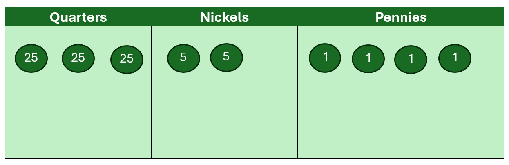
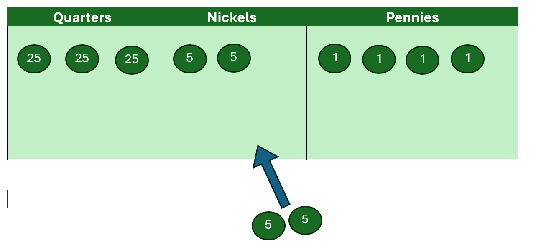
In this book we will use both Quinary as well as Decimal to illustrate the chip model for the binary operations. In the quinary, numbers can be represented using chips placed in special columns. At first they would be labeled with their corresponding values. For example, here is \((324{)}_{5}\):
Example 1: What number is \((20{)}_{5}\) more than \((324{)}_{5}\)?
Solution: By introducing 2 more nickels, we obtain a total of 4, giving us \((324{)}_{5}+(20{)}_{5}=(344{)}_{5}\)
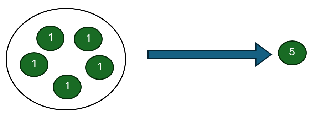
Rebundling in Quinary is easier to illustrate because of the fewer chips needed. We can rebundle 5 pennies for a nickel:
Addition without rebundling is easy: \((321{)}_{5}+(123{)}_{5}\)

The addends are color coded, and note that the chips are lined up as if in a 5-frame:

This would encourage the idea that once we obtain 5 chips we must rebundle.
Once students have developed a sufficient understanding of the place-value idea, we are now ready to remove the labels on the chips, and learn to add with rebundling.
Example: Add \((314{)}_{5}+(34{)}_{5}\) using the chip model.
Solution:
STEP 1: We begin by depicting the first addend in green, and the second addend in blue chips. Note the arrangement of chips in a 5-frame (in rows of five).
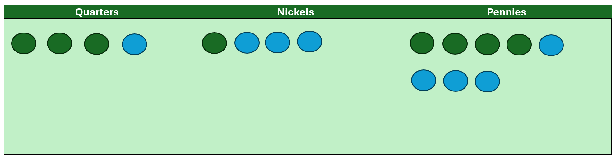
STEP 2: Since we 5 or more chips in the Pennies place, we must bundle these, and exchange 5 of them for a nickel. We depict this by crossing out the pennies we are exchanging. The new orange nickel is the value that was obtained after the exchange.
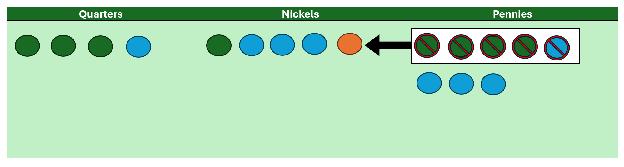
STEP 3: We continue this process of bundling the nickels in a quarter (in orange), and finally we note that we need to add a new denomination value, the \(125={5}^{3}\), which we are calling the Quavers.
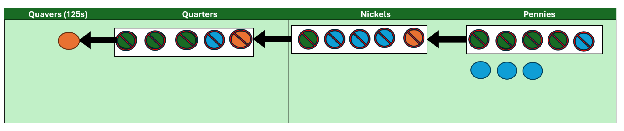
The sum can now be read from the final chip model: 1 quaver, 0 quarters, 0 nickels, and 3 pennies: \((1003{)}_{5}\).
Although we are illustrating the addition algorithm using Quinary, the process is identical in decimal.
3.1.9 The Classic Subtraction Algorithm
Let’s illustrate the subtraction process using Quinary once again.
Example: Subtract \((432{)}_{5}-(321{)}_{5}\)
Solution: Note that this particular subtraction process is easy because all the digits in the subtrahend are smaller than their corresponding digits in the minuend. Hence, there is no need for rebundling, or decomposing of any higher value units.
We begin by drawing the chip diagram with the chips in the minuend. The chips representing the subtrahend would not be represented.
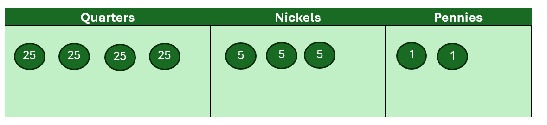
We then begin to cancel out the chips based on the subtrahend:
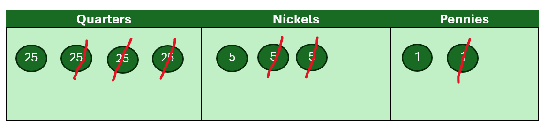
Example 2: \((301{)}_{5}-(43{)}_{5}\)
Solution: In this case the subtraction process will require rebundling, or exchanging higher values units for lower ones. Furthermore, this particular example involves a particular instance of “subtraction across zero”. We begin by depicting the minuend using chips:
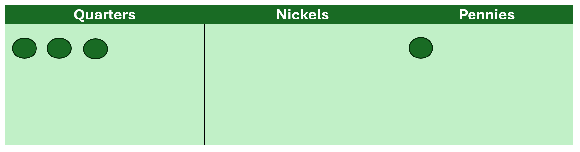
We need to take away 3 pennies, and 4 nickels. Evidently we don’t have enough pennies to take away. We then must exchange a higher value unit, one of the quarters. We decompose one of the quarters into 5 nickels, and then we subsequently decompose one of the nickels for 5 pennies. We depict this by crossing-out the quarter, and the nickel we exchanged. Note the newly obtained values from the exchange in depicted in orange.
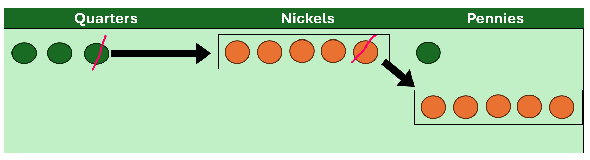
The main task of subtraction can now begin by taking away (i.e. crossing-out) the corresponding values in the subtrahend \((43{)}_{5}\). It’s notable that most of our work so-far has not even involved any taking away of any values.
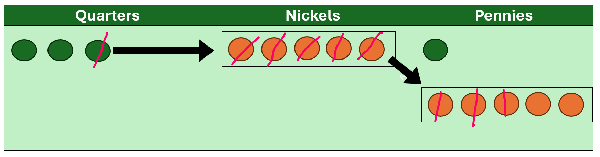
The final answer can now be read from the final chip diagram: We have 2 quarters, 0 nickels, and 3 pennies left. Thus the difference is \((203{)}_{5}\).
3.1.10 Teaching Sequence for Addition and Subtraction per California Common Core Standards
Kindergarten (K.OA, K.NBT)
Foundational Number Sense: Students learn to count, represent numbers, and combine sets of objects. Begin using the language of addition and subtraction (e.g., “put together” and “take a way”) with small numbers (typically up to 10).
Concrete, Contextual Problems: Simple story problems, manipulative-based activities (blocks, counters), and pictorial representations introduce the concepts informally.
Grade 1 (1.OA, 1.NBT)
Addition & Subtraction Within 20: Emphasis on using strategies (counting on, making ten, decomposing numbers) to solve addition and subtraction facts.
Use of Conceptual and Visual Models: Use number lines, ten-frames, and drawings to deepen understanding of how numbers combine and separate.
Place Value to 100: Students begin exploring tens and ones, laying groundwork for two-digit addition and subtraction.
Grade 2 (2.OA, 2.NBT)
Addition & Subtraction Within 100: Strengthen mental strategies and introduce more formal algorithms as appropriate.
Place Value Strategies: Use place-value understanding (tens and ones) to compose and decompose numbers.
Word Problems: Solve one- and two-step problems in real-world contexts, focusing on clarity in interpreting remainders or differences.
Grade 3 (3.NBT)
Fluent Addition & Subtraction Within 1,000: Develop accuracy and efficiency with multi-digit addition and subtraction, often using the standard algorithm.
Application: Engage with word problems involving larger numbers, money, and measurement, further solidifying place-value concepts.
Grade 4 (4.NBT)
Multi-Digit Whole Number Addition & Subtraction: Extend to larger numbers (up to millions) with the standard algorithm.
Estimation Skills: Emphasize estimation and reasonableness of answers (e.g., rounding, front-end estimation) to check work.
Grade 5 (5.NBT)
Decimals (Addition & Subtraction: Add and subtract decimals to hundredths, aligning decimal points and using place-value strategies.
Word Problems with Decimals: Apply operations to real-life scenarios involving money, measurement (liters, meters), and more.
Grade 6 (6.NS)
Fraction Addition & Subtraction: Extend earlier fraction concepts by finding common denominators, simplifying results, and applying to real-world contexts.
Foundation for Future Topics: Sets the stage for rational number operations (including negative numbers) in Grade 7 and introduces more complex multi-step word problems.
3.2 Exercises on Addition & Subtraction
- Illustrate the equality \(3+4\ =\ 4+3\) by using (a) the set model, and (b) a bar/strip diagram.
- Fill in the blanks to explain why each line follows from the previous:
| $(3+7)+5 $ | \(=3+(7+5)\) | by the associative property of addition |
|---|---|---|
| \(=3+(5+7)\) | by the _______________________ property | |
| \(=(3+5)+7\) | by the _______________________ property |
- For the following word problems that use subtraction to identify whether it uses the take-away, comparison, or part-whole interpretations:
- Sofia has 12 crayons, and Miguel has 7 crayons. How many more crayons does Sofia have than Miguel?
- Lucia has 18 stickers, and Javier has 9 stickers. How many more stickers does Lucia have than Javier?
- Elena collected 22 seashells, while Mateo collected 14 seashells. How many more seashells does Elena have than Mateo?
- Emily has 15 balloons for her birthday party. After the party, she gave 7 balloons to her friends. How many balloons does Emily have left?
- A zoo had 25 penguins. Over the summer, 11 penguins were moved to another zoo. How many penguins are left at the zoo?
4. Illustrate the following addition and subtraction problems using their appropriate models:
- \(3+4\) using the number line model
- \(7-3\) using the number line model
- \(8-5\) using the set model and by crossing out objects
5. Do the indicated calculations mentally (and describe this by using parentheses) by looking for pairs whose difference is a multiple of 10:
- $34+17-24-27$
- \(28-16+36-4\)
- \(39-15-25-19\)
6. Describe how you would perform the following operations using compensation:
- \(57-19\)
- \(87\ -\ 18\)
- \(95-37\)
- \(137\ -\ 109\)
- \(3237\ -\ 1999\)
7. Make a first grade word problem of the following types:
- Using the take-away interpretation for finding \(17-9\)
- The part-whole interpretation for \(26-7\)
- The comparison interpretation for \(17-4\)
8. Use compensation to find the following sums. Draw arrows representing the “passing on” or “one addend giving a quantity to another”:
| \(58+32\ =\) ___________ | $341 + 97 =$___________ | $45 + 47 =$___________ |
|---|---|---|
| \(139+107=\ ___________\) | $893 + 328 =$___________ | $999 + 9999 =$__________ |
9. Which thinking strategy or arithmetic property (or properties) is being used?
- \(89\ +\ 33\ =\ 90\ +\ 32\)
- \(13,307\ +\ 23,104\ =\ 23,104+13,307\)
- \(7+0=7\)
- \(17\ +\ (19+34)\ =\ (17+19)+34\)
- 3 thousands and 4 ones is equal to 4 ones and 3 thousands
10. Find the missing facts of this additive/subtractive four-fact family:
| \(127-79=\ 48\) |
11. Use the number-bond below to construct its corresponding ten-frame representation, and four-fact family:

12. Illustrate how you would use Adding up from the Subtrahend method to subtract:
- \(73-29\)
- \(178-96\)
- \(425-292\)
13. Illustrate how you would use compensation to perform the following operations
- \(86-19\)
- \(173-129\)
- \(742-199\)
- \(346-204\)
14. Imagine a scenario where \(37-19\) means that you are paying cash for a shirt which costs $19, and you’ve already paid $37 via credit card, and are hoping to get your change which should be the difference $37-19=$18$. Use this hypothetical scenario to justify the Compensation method $(37+1)-(19+1)=38-20=18$ by explaining why adding $1 to the minuend, and the subtrahend, and then subtracting these results will always result in the same difference $18.
15. Make up first grade word problems for the following types:
- Uses the take-away interpretation, and the set model for \(17-9\)
- Uses the comparison interpretation and the set model for \(12-9\)
- Uses the part-whole interpretation and the measurement model for \(37-19\)
- Uses the comparison interpretation and the measurement model for \(17-9\)
16. One of the key grade 1 California Math standard areas describes the expectations from a teacher
(see the paragraph below). Which of the key ideas (if any) from this chapter are conveyed in
this introductory paragraph from the standards.
Students develop strategies for adding and subtracting whole numbers based on their prior work with small numbers. They use a variety of models, including discrete objects and length-based models (e.g., cubes connected to form lengths), to model add-to, take-from, put-together, take-apart, and compare situations to develop meaning for the operations of addition and subtraction, and to develop strategies to solve arithmetic problems with these operations. Students understand connections between counting and addition and subtraction (e.g., adding two is the same as counting on two). They use properties of addition to add whole numbers and to create and use increasingly sophisticated strategies based on these properties (e.g., “making tens”) to solve addition and subtraction problems within 20. By comparing a variety of solution strategies, children build their understanding of the relationship between addition and subtraction.
16. Use a chip diagram to depict the following addition problems in Quinary. Be sure to provide a brief description of the algorithm you performed.
- \((22{)}_{5}+(31{)}_{5}\)
- \((321{)}_{5}+(4{)}_{5}\)
- \((403{)}_{5}+(43{)}_{5}\)
17. Use a chip diagram to depict the following subtraction problems in Quinary. Be sure to provide a brief description of the process you performed.
\((43{)}_{5}-(31{)}_{5}\)
\((321{)}_{5}-(4{)}_{5}\)
 (c) $(41{)}_{5}-(2{)}_{5}$
 (d) $(301{)}_{5}-(104{)}_{5}$
18. What prior place-value and counting skills must students have before tackling two-digit addition and subtraction in Grade 2? Give an example of a Kindergarten or Grade 1 activity that establishes a strong place-value foundation.
19. How do the California standards transition students from concrete (e.g., counters, drawings) to more formal algorithms for addition and subtraction? Why is it important for students to develop both conceptual understanding (visual/mental strategies) and procedural fluency (standard algorithm)?
20. In what ways do the standards incorporate real-life word problems to deepen understanding of multi-digit addition and subtraction? Provide a Grade 3 or Grade 4 word problem example that integrates addition or subtraction.
3.3 Multiplication
3.3.1 Definition of Multiplication, and Division
Multiplication is defined in terms of repeated addition:
\(4\times 5\ =\ 5\ +\ 5\ +\ 5\ +\ 5=20\)
Here we will designate the first factor 4 as the multiplier, which represents the number of times we’ll be adding the multiplicand 5 to itself. The result is the product.
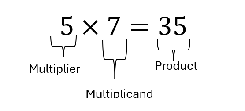
Division, on the other hand, can be defined in several ways:
- In terms of repeated subtraction: \(7\div 3=\) the number of times we can subtract 3 from 7 before reaching a difference less than 3: \(7-3-3=1\), so \(7\div 3=2\) with a remainder 1.
- In terms of a missing factor: Answering \(12\div 3=?\) amounts to filling the blank: \(3\times\) ____ \(=12\)
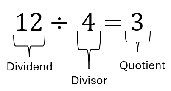
These two operations are also deeply intertwined in terms of their corresponding 4-fact family:
| \(3\times 4=12\) | \(4\times 3\ =\ 12\) |
|---|---|
| \(12\div 3=4\) | \(12\div 4=3\) |
3.3.2 Models for Multiplication
Set Model
Here the multiplier represents the number of groups, collections, or sets, while the multiplicand represents the number of items in each group.
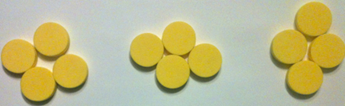
Fostering understanding of this model involves guiding students to show equal groups, and splitting chips or other manipulatives into equal groups.
Exercise: Determine the multiplier, multiplicand, and the product represent in the following set model:

Solution: The multiplier is the number of groups: 5, while the multiplicand is the number of items in each group: 4, so the product is \(4\times 5=20\)
Measurement Model
The measurement model will be used in grades 3 and above to represent more continuous quantities such as meters, feet, pounds, dollars, etc.. For example, if we have a 5 units of 4lbs, then we have a total of \(5\times 4lb\ =\ 20lb\).
Note that in this example, the multiplier represents number of copies and is unitless, whereas the multiplicand has physical units attached, namely pounds, and so does the product 20lb. The measurement model would the paramount model we’ll use in the course for word problems.
Number-Line Model
The number line model for multiplication will be similar to the addition model, except we would start from 0, and use the multiplier amount to measure the number of jumps to take from 0 each of which will be of a size determined by the multiplicand. Below we can see the representation of \(3\times 6=18\) using the number line model.

Rectangular Array Model
The rectangular array model is also introduced beginning 3rd grade. The rows represent the multiplier, while the columns represent the multiplicand. Below is a representation of \(3\times 4\):
The rectangular array model is extremely versatile because via the multiplication/division four-fact family for \(3\times 4=12\) we can use it to represent the following ideas:
- 3 rows of 4 columns is 12 items
- 4 columns of 3 rows is 12 items
- 12 is evenly divisible by 3
- 12 is evenly divisible by 4
- 3 is a factor of 12
- 4 is a factor of 12
- 12 is a multiple of 3
- 12 is a multiple of 4
3.3.3 Properties of Multiplication
The Identity Element
Multiplication is associated with a special number, namely 1, which has the following property: \(a\times 1=1\) for any number a.
Commutative Property
Changing the order of multiplication does not yield different products: \(a\times b=b\times a\)
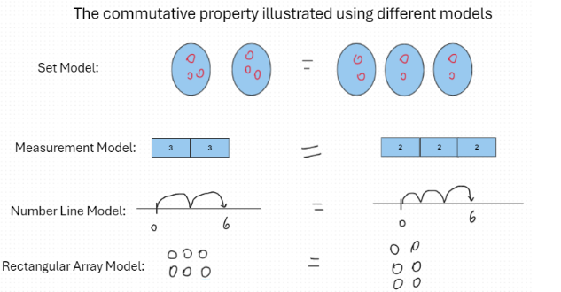
The set model and measurement model are less effective at illustrating the commutative property of multiplication for 2nd and 3rd graders because they assign different roles to each factor, which can visually confuse young learners. In the set model, multiplication is shown as groups with objects, making \(3\times 4\) (3 groups of 4) look different from \(4\times 3\) (4 groups of 3), despite the product being the same. Similarly, in the measurement model, \(3\times 4\) is depicted as a certain length composed of equal segments, but swapping the factors changes the appearance of the segments, making it harder for students to intuitively see that the total remains the same.
The rectangular array model, on the other hand, is far more effective at showing the commutative property. By arranging multiplication as rows and columns, students can clearly see that \(3\times 4\) and \(4\times 3\) both create the same area, just rotated differently. This visual symmetry makes it easier for students to understand that the order of factors doesn’t matter, while also providing a concrete and engaging hands-on learning experience. This makes the array model a much better tool for helping young learners grasp multiplication’s commutative property.
Associative Property
Known also as the any-order property for multiplication, this property states that the order of multiplication in \((3\times 4)\times 2\) can be changes to \(3\times (4\times 2)\). Note that the appearance of the number does not change, but merely the operation is different. In algebraic language, the associative property is that for any numbers \(a\), \(b\), and \(c\) we have \((a\times b)\times c=a\times (b\times c)\)
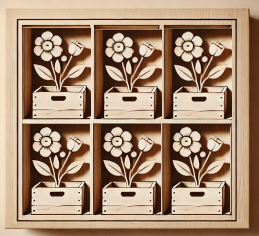
The arrangements of the 2 flowers in each box, which are located on shelves having 2 levels can be used to illustrate the associative property of multiplication: \((2\times 3)\times 2=2\times (3\times 2)\)
To understand the left side of this equation, \((2\times 3)\times 2\), we note that there are 2 shelves, and 3 boxes each. So, the \((2\times 3)\) represents the total number of boxes, and the \((2\times 3)\times 2\) represents all the flowers by multiplying the total number of boxes by the number of flowers in each box.
The right side of the equation leads to the same total number 12, but via a different route: First we calculate the total number of flowers on each shelf: \(3\) boxes times 2 flowers per box \(3\times 2\). We then multiply the total number of flowers on each shelf by the total number of shelves: \(2\times (3\times 2\))
The Distributive Property
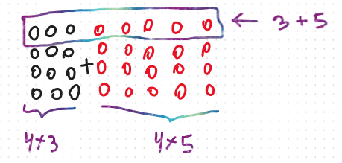
The distributive property can be illustrated using rectangular arrays:
The distributive property can also be represented using the rectangular array model. We begin with an array representing \(4\times 3\) (in black) having 4 rows and 3 columns, and we combine it with an array representing \(4\times 5\) (in red) having the same number of rows, but 5 columns. Their sum, however, can be computed not only by adding the two products \(4\times 3+4\times 5\) but also by seeing the new combined array as having \((3+5)\) many columns, and having \(4\) rows. Thus, this new black and red array is really \(4\times (3+5)\). It follows that \(4\times 3+4\times 5=4\times (3+5)\).
Mastering the commutative, associative, and distributive properties in 2nd and 3rd grades is essential because they underpin the logic of computation and pave the way for understanding more advanced multiplication and division algorithms later on. Specifically, the distributive property is crucial for grasping the logic of two-digit multiplication algorithms, as it allows students to break down complex problems into simpler parts—for example, understanding that \(12\times 3\) can be computed as \(10\times 3+2\times 3\) by distributing the multiplication over addition. By using the rectangular array model or other visual tools, students can intuitively grasp why these properties work, building a strong conceptual foundation without the need to memorize their formal names. This deep understanding empowers students to approach mathematical operations with confidence and prepares them for more complex concepts in the future.
3.3.4 Thinking Strategies, and Building the Skills for the Algorithm
Stage I: This is the introductory period which begins toward the end of Grade 1. Students are exposed to:
- Multiplying by 2, which is learned easily because it’s borrowed from the doubles strategy of addition
- Multiplying by 3 and 4 using skip counting: 0, 3, 6, 9, 12….; and 0, 4, 8, 12, 16, …
- Multiplying by 0 and 1
- Multiplying by 10: \(7\times 10=70\)
Below is the one-digit multiplication table in Quinary. All numbers in the table are in base-5.
| 1 | 2 | 3 | 4 | |
|---|---|---|---|---|
| 1 | 1 | 2 | 3 | 4 |
| 2 | 2 | 4 | 11 | 13 |
| 3 | 3 | 11 | 14 | 22 |
| 4 | 4 | 13 | 22 | 31 |
Stage II: This is a stage which lasts through grade 2, and to the beginning of grade 3 consisting of memorizing the multiplication table, and gaining conceptual understanding of the utilization of the distributive property, and the associative properties in computing products.
Example 1: Compute \(7\times 30\) showing the use of the associative property.
Solution: \(7\times 30=7\times (3\times 10)=(7\times 3)\times 10\ =\ 21\times 10=210\)
Example 2: Use the distributive property to to compute \(7\times 9\):
Solution: \(7\times 9=7\times (10-1)=7\times 10-7\times 1=70-7=63\)
Example 3: Compute \(8\times 15\) using the distributive property:
Solution: \(8\times 15=8\times (10+5)=8\times 10+8\times 5=80+40=120\)
Example 4: Compute \((3{)}_{5}\times (20{)}_{5}\) using the associative property:
Solution: \((3{)}_{5}\times (20{)}_{5}=(3{)}_{5}\times ((2{)}_{5}\times (10{)}_{5})=((3{)}_{5}\times (2{)}_{5})\times (10{)}_{5}=\)
\(=(11{)}_{5}\times (10{)}_{5}=(110{)}_{5}\)
Example 5: Compute \((3{)}_{5}\times (23{)}_{5}\) using the distributive property:
Solution: \((3{)}_{5}\times (20+3{)}_{5}=(3{)}_{5}\times (20{)}_{5}+(3{)}_{5}\times (3{)}_{5}=(110{)}_{5}+(14{)}_{5}=(124{)}_{5}\)
The examples 4, and 5 above illustrate that the thinking strategies employed when multiplying by powers of 10 can be employed in quinary for powers of 5, and that the multiplication algorithm works perfectly in quinary just as in decimal.
3.3.5 The Classic Multiplication Algorithm
In grades 1 through 4, the mathematics curriculum builds progressively, starting with basic number sense and simple operations before moving into more complex concepts. In first grade, students focus on addition, subtraction, and understanding place value, but multiplication is not formally introduced yet. By second grade, multiplication is introduced conceptually as repeated addition, and students begin learning basic multiplication facts, such as 2s, 5s, and 10s. This foundation is further solidified in third grade when students are expected to master all multiplication facts up to 12 × 12. Along with this, they are taught the algorithm for multiplying larger numbers by a 1-digit number.
By fourth grade, students transition into multiplying larger numbers, including learning the standard algorithm for multiplying 2-digit numbers. This involves breaking down multi-digit multiplication into smaller steps using place value, further refining the multiplication skills acquired in previous years. Throughout these grades, students are gradually introduced to more advanced mathematical operations, ensuring they have a solid grasp of fundamental arithmetic as they prepare for more complex concepts in later grades.
The One-digit multiplication Algorithm in Quinary using the Chip Model
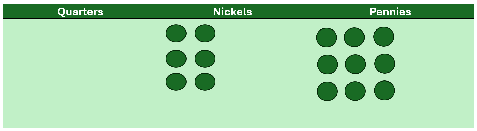
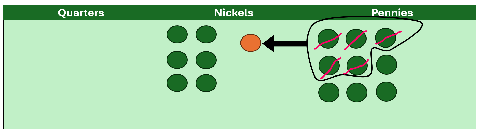
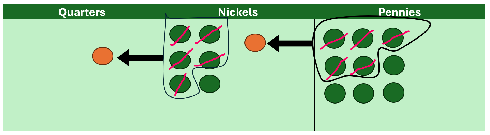
**Example:**  $(23{)}_{5}\times (3{)}_{5}$

**Solution:** 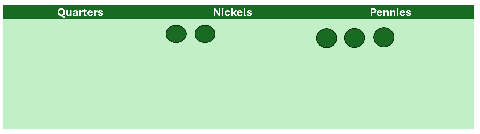
The Curricular Steps to Building the Multi-Digit Multiplication Algorithm
Step 1: No rebundling is necessary: \((2{)}_{5}\times (2{)}_{5}=(4{)}_{5}\)
Step 2: Basic rebundling: \((3{)}_{5}\times (2{)}_{5}=(11{)}_{5}\)
Step 3: Basic rebundling with 2-digit multiplicand: \((3{)}_{5}\times (23{)}_{5}\ =(124{)}_{5}\)
Step 4: Multiplicands with powers of 5 (without rebundling): \((2{)}_{5}\times \ (200{)}_{5}=(400{)}_{5}\)
Step 5: Multiplicands with power of 5 (with rebundling): \((300{)}_{5}\times \ (4{)}_{5}=(2200{)}_{5}\)
Step 6: The application of the distributive, and commutative properties to multiplying multi-digit multipliers, and multiplicands:
\((23{)}_{5}\times (34{)}_{5}=((20{)}_{5}+(3{)}_{5})\times (\ (30{)}_{5}+(4{)}_{5})\ =\)
\(=(20{)}_{5}\times (30{)}_{5}+(20{)}_{5}\times (4{)}_{5}+(3{)}_{5}\times (30{)}_{5}+(3{)}_{5}\times (4{)}_{5}\)
The multi-digit multiplication algorithm in Quinary
Let’s multiply \((234{)}_{5}\times (32{)}_{5}\).
The algorithm is based on rewriting each of the numbers as sums of its place-value parts, and then using the distributive property to multiply the parts:
\((32{)}_{5}\times (234{)}_{5}=((2{)}_{5}+(30{)}_{5})\times ((4{)}_{5}+(30{)}_{5}+(200{)}_{5})\)
Step 1: We begin by distributing the \((2{)}_{5}\):
\((2{)}_{5}\times\)\(((4{)}_{5}+(30{)}_{5}+(200{)}_{5})=\)
\((2{)}_{5}\times (4{)}_{5}+(2{)}_{5}\times (30{)}_{5}+(2{)}_{5}\times (200{)}_{5\ }\)
We begin by multiplying the ones digit 2 in \((32{)}_{5}\) by \((234{)}_{5}\):
2 times the 4 ones is \((13{)}_{5}\), so we write down the 3 ones in the ones place, and carry the 1 five
(in orange) into the 5s place. Next, we multiply the 2 by the 3 fives or \((30{)}_{5}\). Now, \((2{)}_{5}\times (3{)}_{5}=(11{)}_{5}\). Of course this \((11{)}_{5}\) actually represents fives since we are not merely doing \(2\times 3\) but actually \((2{)}_{5}\times (30{)}_{5}=(110{)}_{5}\). We now add the 1 five that we carried to the 11 gives to get 12 fives. We put the 2 fives in the fives places, and carry the 10 fives (represented as 1 twenty-five) into the 25s place. Finally, we multiply the 2 by the \((200{)}_{5}\) or the 2 twenty-fives, obtaining 4 twenty fives, or \((400{)}_{5}\). We add the 1 twenty-five that we carried from the fives (i.e. the \((100{)}_{5})\), and obtain \((1000{)}_{5}\). We put this 1 quaver (i.e. hundred twenty-five) in the quavers place. Thus we now have \((1023{)}_{5}\)
Step 2: Next we distribute the \((30{)}_{5}\) by multiplying it one-by-one by the \((4{)}_{5}\), \((30{)}_{5}\), and \((200{)}_{5}\):
$(30{)}_{5}\times ((4{)}_{5}+(30{)}_{5}+(200{)}_{5})=$

$(30{)}_{5}\times (4{)}_{5}+(30{)}_{5}\times (30{)}_{5}+(30{)}_{5}\times (200{)}_{5}$


We begin by multiplying the 3 fives by the 4 ones, or $(30{)}_{5}$ by $(4{)}_{5}$obtaining\((220{)}_{5}\). We put down the 0 ones in the ones place, the 2 fives in the fives place,
and we bundle the 2 quarters, and carry it to the quarters place. We are now ready to multiply the \((30{)}_{5}\) by \((30{)}_{5}\). Of course we simply think of it as \((3{)}_{5}\times (3{)}_{5}\) obtaining \((14{)}_{5}\). Of course, in reality this is actually \((1400{)}_{5}\), i.e. this (14) actually represents quarters. So we add this value to the 2 quarters that were carried over, obtaining:
\((14{)}_{5}+(2{)}_{5}=(21{)}_{5}\). We now put the 1 quarter of \((21{)}_{5}\) in the quarters place, and carry the \((20{)}_{5}\) quarters over as 2 quavers in the quavers place (i.e. 125s). Finally, we multiply the \((30{)}_{5}\) by the \((200{)}_{5}\) by simply doing \((3{)}_{5}\) \(\times\)\((2{)}_{5}\), obtaining \((11{)}_{5}\). We add the 2 that was carried over to get \((11{)}_{5}+(2{)}_{5}\) to get \((13{)}_{5}\). This \((13{)}_{5}\) is of course quavers, so we put the 3 in the 125s place, and the 1 in the 625s place.
Step 3: We now will add the \((1023{)}_{5}\) with the \((13120{)}_{5}\) to obtain \((14143{)}_{5}\).
Multi Digit Classic Multiplication Algorithm in Decimal
When multiplying 23 by 231, we first note that 23 is composed of 3 (in the ones place) plus 20 (in the tens place), and 231 is composed of 1 (ones), 30 (tens), and 200 (hundreds). By using the distributive property, we break the multiplication into partial products: 3×1, 20×1, 3×30, 20×30, 3×200, and 20×200. Each of these products corresponds to aligning the digits with their respective place values: for instance, the “3×1” focuses on the ones digits, while “20×200” covers tens times hundreds. We then add these partial products together to get the final answer. The commutative property assures us that 3×1 is the same as 1×3, so we can reorder multiplications if needed, and the associative property allows us to group terms for convenience. Additionally, knowing the properties of powers of 10 (like 20 being 2×10 and 200 being 2×100) helps break down each multiplication quickly. By mastering these properties and place-value alignments, we can systematically compute any multi-digit multiplication problem in decimal.
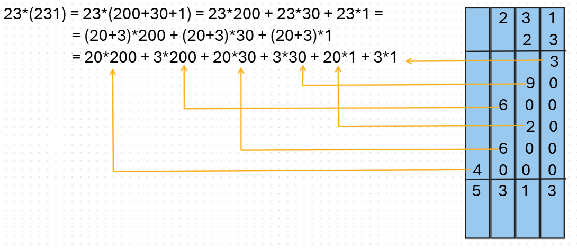
As the diagram above illustrates, the classic multiplication algorithm ultimately corresponds to rewriting 23*231 in expanded form: 23 = 20+3, and 231 = 200 + 30 + 1, then utilizing the distributive property to completely expand the products into sums of products. Each row in the vertical multiplication algorithm corresponds to one of the products. After a while children will omit the 0s in the vertical procedure, and simply learn to place each digit in its appropriate column.
3.3.6 Teaching Sequence For Multiplication
Kindergarten (K.OA, K.CC)
Foundational Number Sense: Students learn to count, group objects, and identify sets.
Early Exposure to “Groups”: Although formal multiplication is not introduced, activities like skip-counting (by 2s, 5s, 10s) and grouping objects in equal sets begin laying the groundwork for multiplication concepts.
Grade 1 (1.OA)
Addition and Subtraction Focus: Emphasis is on addition/subtraction within 20.
Subtle Multiplicative Thinking: Teachers may show informal repeated addition or simple “equal group” scenarios, but multiplication is not explicitly taught. Students continue to strengthen counting skills and number sense.
Grade 2 (2.OA, 2.NBT)
Arrays and Repeated Addition: Students work with arrays (up to 5×5) and use repeated addition to explore the idea that \(4+4+4=3\times 4\).
Foundation for Formal Multiplication: Understanding how equal groups function sets the stage for Grade 3.
Grade 3 (3.OA)
Formal Introduction to Multiplication and Division (Within 100)
Students learn multiplication facts (0–9) and relate them to division, understanding these operations as inverse processes.
Arrays, Area Models, and Word Problems: Visual models help students conceptualize multiplication; word problems reinforce real-world application.
Fact Fluency: There is a strong emphasis on mastering multiplication facts through 10 × 10.
Grade 4 (4.OA, 4.NBT)
Multi-Digit Multiplication: Students progress from single-digit facts to multi-digit (e.g., two-digit by two-digit) multiplication.
Strategies and Algorithms: They use distributive property, partial products, and eventually standard algorithms.
Factors and Multiples: Students learn about prime vs. composite numbers and factor pairs, deepening their number sense and multiplicative understanding.
Grade 5 (5.NBT)
Multi-Digit Whole Number and Decimal Multiplication: Extend multiplication to larger whole numbers (e.g., 3-digit by 2-digit) and decimals (e.g., 1.2 × 3.4).
Application: Word problems involving measurement conversion, area/volume, and scaling make multiplication more contextual.
Grade 6 (6.NS, 6.RP)
Fraction Multiplication: Students multiply fractions and mixed numbers e.g., \(\frac{3}{4}\times 2\) or \(\frac{2}{3}\times \frac{4}{5}\).
Foundations for Ratio and Proportional Reasoning: Students use multiplication skills to understand unit rates, scaling, and more advanced problem-solving.
Connection to Future Topics: This prepares students for more formal algebraic work, including expressions and equations, in Grade 7.
3.4 Exercises on Multiplication
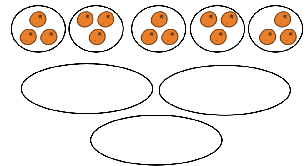
- Redraw the oranges to make 3 equal groups:
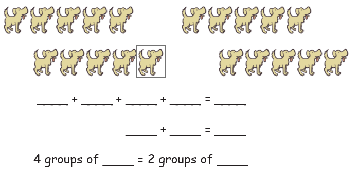
Fill in the blank for repeated addition, then rearrange the dogs into a new grouping:
Groups of dogs Explain how the associative property of multiplication can be used in order to solve the following problem in two ways:
Jason bought 2 boxes of cookies. Each box contained 6 cookies. If each cookie by itself costs $3, what was the total cost?
Represent \(5\times 7\) using the (a) set model, (b) measurement mode, (c) rectangular array model, and (d) the number line model.
How can we use the known fact such as \(6\times 5=30\) in order to find a related fact such as \(6\times 6\) or \(6\times 7\) using the distributive property?
Draw a diagram similar to the shelves, boxes, and flowers in order to illustrate the associative property: \((2\times 3)\times 5\ =\ 2\times (3\times 5)\). Be sure to explain how the LHS (left hand side) of the equation represents a different methodological process compared to the RHS (right hand side).
One can multiply by 5 using the following method based on the associative property:
\(5\times 24\ =\ 5\times (2\times 12)=(5\times 2)\times 12=10\times 12=120\)Thus, we just need to take half of the multiplicand, and multiply by 10 instead (assuming the
multiplicand is even).
Use this method to show how you would multiply:
\(5\times 84\)
\(5\times 2468\)
\(5\times 64804\)
To multiply 5 by an odd number using this technique, we would multiply by the even number which is 1 less than the multiplicand, then add 5 at the end. For example,
\(5\times 6481\ =\ 5\times (6480+1)=5\times 6480+5=5\times (2\times 3240)+5=\)
\(=(5\times 2)\times 3240+5=10\times 3240+5=32400+5=32,405\)
Use this method to multiply (try doing this in your head, but write down the steps on
your paper):
- \(5\times 46801\)
- \(5\times 1247\)
- One can multiply by 9 also using a property of multiplication, but this time the distributive property: \(7\times 9=7\times (10-1)=7\times 10-7\times 1=70-7=63\)
Draw a rectangular array (as employed in illustrating the distributive property) to illustrate the method for finding \(9\times 4\)
Use this method to mentally multiply the following numbers by 9: 5, 6, 13, 17, 79. Be sure to provide the steps using the distributive property in your response.
In quinary the number that plays the same role as 9 is \((4{)}_{5}\) because \((4{)}_{5}\) is 1 less than the base number. Use a similar method as in decimal to multiply \((4{)}_{5}\times (13{)}_{5}\). Is this methodology as useful in quinary as it is in decimal?
- Draw a chip diagram and provide a brief explanation for the following single digit multiplication problems in quinary:
- \((2{)}_{5}\times (14{)}_{5}\)
- \((3{)}_{5}\times (32{)}_{5}\)
- Draw a chip diagram and provide a brief explanation for the following single digit multiplication problems in decimal:
- \(7\times 14\)
- \(3\times 34\)
- Multiply the following numbers in quinary using the vertical method, and then provide a step-by-step explanation of your methodology. Feel free to use the simplified multiplication table in quinary below:
| 2 | 3 | 4 | |
|---|---|---|---|
| 2 | 4 | 11 | 13 |
| 3 | 11 | 14 | 22 |
| 4 | 13 | 22 | 31 |
- \((324{)}_{5\ }\times \ (4{)}_{5\ }\)
- \((23{)}_{5}\times (32{)}_{5}\)
- \((243{)}_{5}\times (24{)}_{5}\)
12. What essential knowledge about place value, grouping, and addition do students need before they can fully grasp multiplication in Grade 3? Provide one example of a Grade 2 activity that helps build this foundation
13. Which visual models (e.g., arrays, area models) are most effective for introducing multiplication, and why? How do these models evolve as students move from single-digit to multi-digit multiplication?
14. How do the California Mathematics standards promote a balance between conceptual understanding (e.g., arrays, number sense) and procedural fluency (e.g., memorizing facts, standard algorithms)? Why is mastery of basic multiplication facts by the end of Grade 3 critical for success in Grades 4–6?
15. At which grades do fractions and decimals become part of multiplication, and how do these new contexts build on earlier whole-number multiplication skills? Give a specific example of how a teacher might link a Grade 5 decimal multiplication problem to the student’s prior knowledge of multi-digit multiplication.
16. In Chapter 2 of her book Knowing and Teaching Elementary Mathematics Liping Ma emphasizes the importance of a profound understanding of fundamental mathematics in teaching, particularly in topics such as multiplication. Discuss how an understanding of place value plays a critical role in teaching and learning multiplication. How can teachers use the concept of place value to help students understand multiplication beyond memorizing times tables?
17. Perform the multiplication problems \(735\times 37\) in decimal. Then expand 735, and 37 and use the distributive property to show (by drawing arrows as in the diagram in section 3.2.4) that the summands after applying the distributive property correspond to the numbers in the rows of the vertical version of the classic multiplication algorithm.
3.5 Division, and the Division Algorithm
3.5.1 Definition and the Interpretations of Division
The dividend is the number we are splitting up into a number of parts represented by the divisor, or counting the number of copies of the magnitude defined by the divisor within it. The quotient is the resulting number of this operation.
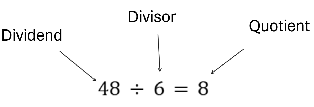
Just like subtraction is defined in terms of a missing addend, division can be defined in terms of the missing factor in a multiplication operation. In fact, if the missing factor is the multiplicand then we shall call this measurement division, and if the missing factor is the multiplier then this is partitive division.
Definition: This missing quotient in \(48\div 6\ =\) _____ can be defined either as the missing multiplicand as in \(6\times\) ______ \(=\ 48\), or as the missing multiplier as in ______\(\ \times 6\ =48\). Because multiplication is commutative, both of the former multiplication equations yield the same answer 48, which represents the dividend in the corresponding division problem.
As with addition, subtraction, and multiplication, division can also use different models as in set, and measurement. Thus, we have a confusing scenario here: the term ‘measurement’ could refer to both the model, as well as the interpretation of division. For this reason we will primarily avoid talking about division models, and instead focus on interpretations, which are more intriguing anyway
| Interpretation | Related Question | Diagram |
|---|---|---|
| Partitive Division | What is the size of each part when 20 meters is divided into 5 equal parts? | 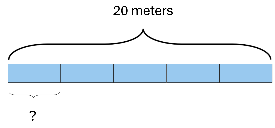 |
| Measurement Division | How many copies of magnitude 5 meters are there in 20 meters? | 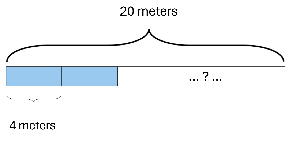 |
Example 1: 5 packets of sugar weigh 600 g. How much does each packet weigh?
| This problem is asking for the magnitude of the size of each packet of sugar. Notice that the dividend has a unit of measurement, grams attached to it, but the divisor 5 does not. This is an indication that we are dealing with partitive division. The corresponding bar diagram reflects this. | 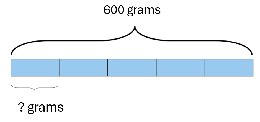 |
|---|
Example 2: Jose made 120 cupcakes. He put them into boxes of 6 cupcakes each. How many boxes of cupcakes did Jose prepare?
| This problem asks for the number of copies of the 6 cupcakes within 120 cupcakes. Note that in contrast Example 1, both the dividend, and the divisor have associated units of measurement: cupcakes. This means we are dealing with measurement division. | 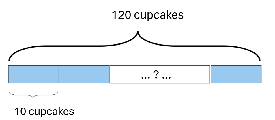 |
|---|
Guide to Distinguishing Between Partitive, and Measurement Division
- Identify the dividend, and the divisor in the problem.
- Do the units of measurement in the dividend, and the divisor match? If so, then this is most likely a measurement division problem. If not, this is likely a partitive division problem.
- Try rephrasing the word problem in simpler terms. Suppose D is the dividend, and d is the divisor, can the word problem be rephrased as:
- “What is the size of each part after D is split up into d parts?” → Partitive Division
- “How many copies of size d are there in D?” → Measurement Division
- “What is the size of each part after D is split up into d parts?” → Partitive Division
The Quotient - Remainder Theorem
The concept of the remainder is introduced in 3rd grade, and it arises in both the measurement, and partitive division contexts. For example, when we ask: How many dozens are there in 30 eggs? The answer is 2 dozens, with 6 eggs remaining, and we can write: \(2\times 12\ +\ 6\ =\ 24\ +6\ =\ 30\) eggs. Similarly, how many feet are there in 70 inches? The solution is that there are 5 feet, with 10 inches remaining because \(5\times 12\ +\ 10\ =\ 60+10\ =\ 70\) inches. All division problems where the divisor is not a factor of the dividend give rise to the so-called Quotient-Remainder theorem.
Theorem 3.3.1 The Quotient Remainder Theorem: Let \(N\) be a whole number, and let \(d\) be a divisor such that \(d\ne 0\). There are unique whole numbers \(q\) (the quotient) and \(r\) (the remainder) such that
\(N\ =\ (d\times q)+r\) and \(0\leq r<d\)
We can represent small squares to represent individual numbers, arranging them in such a way as to help us depict whether individual numbers are divisible by certain values. For example, to illustrate that 10 divided by 4 leaves a remainder of 2 we can depict 10 using the following diagram:
| In the division diagram to the right the total number of squares represents the dividend \(D=10\), the rows represent the divisor \(d=4\), the completed columns in white represents the quotient \(q\), while the two remaining squares (in orange) represent the remainder since \(10\div 4=2R2\). This means we can write the following multiplication equation: \(10=2\times 4+2\) | 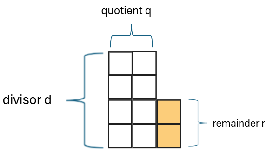 |
|---|
| Example 1: Suppose we are dividing 14 by 3. We could try to put 14 blocks into 3 equal rows, and see if this can be done equally. The attempt can be seen on the right where we have a remainder of 2, and a quotient of 4. This means that we can write: \(3\ \times 4\ +\ 2\ =\ 14\) or equivalently, \(14\div 3\ =\ 4\ R\ 2\) | 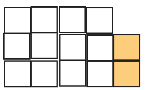 |
|---|
Here are key takeaways based on the diagrams above:
- Could the remainder ever be the same as the divisor? NO: since otherwise we would have a complete rectangle, and no remainder!
- Could the remainder be larger than the divisor? NO: the remainder must always be less than the divisor!
Remainders are formally introduced in Grade 3, where students work on basic division concepts (e.g., 3.OA.2–4 in the California Common Core) and learn that a “leftover” quantity may result when dividing. Word problems illustrate this by asking, for example, how many apples remain if 14 are shared among 4 students. In Grade 4, division expands to larger dividends (up to four-digit numbers divided by one-digit numbers), making remainders more visible in multi-digit division algorithms. By Grade 5, students progress to dividing by two-digit divisors and decimals, shifting their focus toward mastering long division. Even though decimals often absorb what would otherwise be an integer remainder, the underlying idea of a leftover amount remains an important thread in students’ conceptual understanding.
The formal Quotient-Remainder Theorem is typically introduced at the college level or in advanced high school electives. Nevertheless, K–12 students use this principle whenever they perform or interpret integer division, beginning in Grade 3 and continuing through middle and high school. By late elementary and middle school, they handle remainders with ease, applying the concept in increasingly sophisticated contexts—such as polynomial division or modular arithmetic if offered in advanced courses. Though the theorem itself is not labeled or proved in standard K–12 curricula, its practical application underlies countless computational and problem-solving activities, reinforcing the unique quotient-remainder relationship at every step.
3.5.2 The Division Algorithm
The division algorithm is one of the cornerstones of elementary school mathematics learning, providing a structured method to divide one number by another while also offering opportunities to explore foundational concepts essential for future mathematical growth. Although the algorithm is essentially a piece of procedural knowledge it is indispensable for conceptual understanding. For one, it serves as a bridge between the abstract and the concrete, illustrating how fractions can be related to decimals by dividing the numerator by the denominator. Beyond its practical applications, the division algorithm introduces the concept of iterative or recursive thinking, as students engage in successive approximations to refine their results. Additionally, it lays the groundwork for advanced topics, such as dividing polynomials or working with partial fractions, ensuring that procedural fluency today fosters conceptual understanding tomorrow. While the algorithm may seem mechanical, its role in developing key mathematical skills and preparing students for complex algorithms makes it an indispensable teaching tool.
The Partitive Interpretation of the Long Division Algorithm
This approach uses the idea that we are splitting up the dividend into a given number of pieces based on the divisor.
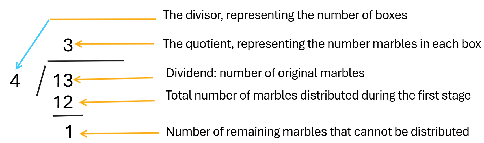
Example 1: Juanita put 13 marbles equally into 4 boxes. After she was done, there were ______ many marbles in each box, with _____ marbles completely distributed, and ______ marbles were left over.
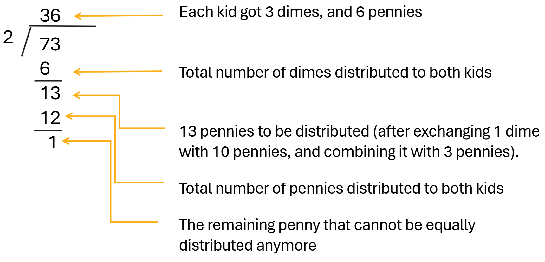
Example 2: Jason, and Helena want to slit 73 cents (7 dimes, and 3 pennies) equally. After they split the 7 dimes, and 3 pennies equally among themselves, each get _____ dimes, and _____ cents, and there are ______ cents left over undistributed.
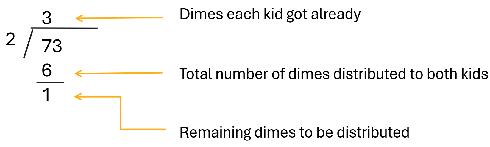
At this point a procedural lesson would state that we must “bring down” the 3 pennies, and put it next to the 1 remaining dime. However, the key concept to understand is that the remaining dime cannot be split into two parts. To distribute it we must convert it to 10 pennies first, so this is what the “bringing down” of the 3 pennies actually represents. It involves the exchange of the dime with lower value units: pennies.
The Measurement Division Approach of the Long Division Algorithm
The long division algorithm primarily works based on the partitive division model, however, once can use the measurement division interpretation as well, especially when introducing the algorithm.
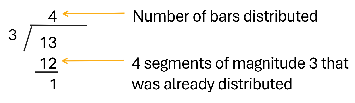
Example 3: Compute \(13\div 3\) using the measurement model (NOTE: This is not the measurement interpretation of division).
We lay out a bar of 3 units long along the number line, and try to fit as many of the bar as we can along the length reaching 13. It’s clear that there are 4 copies of 3 that can fit within a 13. The remainder then can be computed by subtracting this product from 13: \(13\ -\ 4\cdot 3\ =\ 13-12=1\)

Example 4: Divide \(347\div 5\) using the measurement division model.
Solution: Although we cannot draw a number line depicting 347, we could imagine laying down units of magnitude 5 on the number line. We would proceed as follows:
- How many copies of 5 are there within the first 300? Since there are six 5s within a 30, there should be sixty 5s within 300. So, we could put 6 within the hundreds place in the division algorithm tabular form.
- We now have a remainder of 347-300 = 47. How many 5s are there within the 40? There should be 8! So, we put 8 in the tens place.
- The remainder is 47-40 = 7. So, how many 5s are there within that 7? The answer is 1, with a remainder \(7-5=2\).
- Thus, the quotient is \(60+8+1=69\), with a remainder of 2. Note: \(69\times 5+2\ =345+2=347\)
3.5.3 Teaching Sequence for Division Per California Common Core Standards
Grade 2 (Foundations)
Contextual Introduction: Students begin to understand division conceptually through “equal sharing” or “grouping” scenarios (often informally and in conjunction with multiplication).
Focus:
- Recognizing that division is the inverse of multiplication.
- Using simple word problems and concrete objects (e.g., sharing equally among groups) to build intuition.
Grade 3 (Formal Introduction)
Operations & Algebraic Thinking:
3.OA.2–4: Introduction to division facts and strategies (e.g., repeated subtraction, fact families).
- Emphasis on understanding the meaning of division: sharing equally, grouping objects, and connecting it to multiplication (fact families).
Fluency Goals: By the end of Grade 3, students should have basic fluency with multiplication and division within 100 (e.g., knowing 8 × 7 = 56, so 56 ÷ 7 = 8).
Word Problems: Solve one-step word problems involving division, interpret the quotient, and reason about remainders in simple contexts.
Grade 4 (Building Multi-Digit Skills)
Operations & Algebraic Thinking: Continue deepening understanding of multiplication and division relationships, especially with multi-digit numbers.
Number & Operations in Base Ten:
4.NBT.6: Divide up to four-digit dividends by one-digit divisors.
- Students learn partial quotients, long division algorithms, and strategies such as place-value reasoning.
Word Problems:
- Multi-step word problems with addition, subtraction, multiplication, and division.
- Interpretation of remainders becomes more nuanced.
Grade 5 (Multi-Digit & Decimal Division)
Number & Operations in Base Ten:
5.NBT.6–7: Extend division to two-digit divisors and decimal division (e.g., 4.5 ÷ 0.9).
- Practice in developing procedural fluency and efficiency with long division.
Application:
- Use division in more complex real-world problems, including scaling by fractions or decimals.
- Continue to interpret remainders in context, now with larger numbers and decimal places.
Grade 6 (Fractions and Mixed Numbers)
Number System:
6.NS.1: Divide fractions by fractions (e.g., using models or equations to represent division of fractions and mixed numbers).
- Deepen understanding that dividing by a fraction is the same as multiplying by its reciprocal.
Fluency Goals:
- Students become comfortable moving between fractions, decimals, and mixed numbers, applying division in each form.
- Use division to solve real-world problems that involve rates, ratios, and scaling.
Starting in grade 7, students extend their understanding of division to negative rational numbers and more nuanced fraction operations, often applying these concepts in real-world contexts like rates and proportional reasoning. By grade 8, division skills become a crucial tool in algebraic contexts—for example, dividing in linear equations and interpreting slope (rise over run). In high school, the concept of division broadens further to include polynomial long and synthetic division, as well as simplifying rational expressions. Across these upper grades, division is continually integrated into increasingly complex problem-solving scenarios, reinforcing both procedural fluency and conceptual connections to other areas of mathematics.
3.6 Exercises on Division
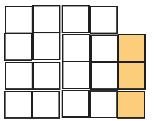
- What division problem does the following array represent? Be sure to write the corresponding equation both in terms of division, and multiplication, identifying the dividend, divisor, and the quotient.
What foundational understandings in place value, addition, and subtraction must students have in place before introducing formal division in Grade 3? Describe at least two examples of how these prerequisite skills support the transition to division concepts.
At which grade level do the California standards formally introduce the concept of remainders, and in what contexts? How does the interpretation of remainders evolve as students progress into Grades 4–5?
Identify the grade levels at which the following division skills appear according to the California standards:
- Multi-digit long division
- Decimal division
- Fraction (and mixed number) division
- Division with negative rational numbers
- Briefly explain why these skills are introduced at these particular stages.
How do the California standards ensure a coherent progression from basic whole-number division in elementary grades through more advanced division topics (e.g., polynomial and rational expression division) in high school? Highlight at least two key milestones in this progression and explain how they connect conceptually.
Identify the following word problems as using the measurement division, or the partitive division interpretation of division.
- A librarian placed 18 books equally across 6 shelves. How many books are on each shelf?
- 7 kids shared 49 balloons equally. How many balloons did each child get?
- Tom bought a 9 m chain, and paid $108. What is the cost of 1 m chain?
- Carlos drove 3234 miles in 3 days. How many miles did he drive on average per day?
- 39 marbles are packed into bags of 3. How many bags are there?
7. Create a word problem based on the following division problems, and use a bar diagram to represent it:
- Measurement division for \(56\div 8\)
- Partitive division for \(132\div 4\)
- Measurement division for \(2000\div 250\)
8. Illustrate the quotient-remainder theorem using the following division problem:
- Using a number line model for \(59\div 10\) (use jumps of 10)
- A set model for \(13\div 3\)
- A rectangular array for \(29\div 6\)
- A rectangular array for \(31\div 8\)
9. Does division have the following properties? If so, explain why, if not provide a
Counterexample. HINT: By choosing specific values of the numbers a, b, and c, give examples
(other than “dividing by zero) showing that each of these three”properties” are actually false.
- Commutative Property: \(a\div b=b\div a\)
- Associative Property: \((a\div b)\div c=a\div (b\div c)\)
- Distributive Property: \(a\div (b+c)=(a\div b)+(a\div c)\)
See Ma, L., & Kessel, C. (2003). Knowing mathematics. Houghton Mifflin P. 10↩︎
NYS Common Core Mathematics Curriculum, Module 6, Lesson 1, p. 13. CC BY-NC-SA↩︎